Search “Odoo vs Cin7” and you’ll find a dozen comparison tables that all look strangely alike. Inventory management: yes for both. Multi-warehouse: yes for both. Barcode scanning: yes for both. Reporting: yes for both. By the time you reach the bottom of the table, you’ve learned that both products can technically do most things, and you’re no closer to knowing which one your business should actually run on.
That’s not because Odoo and Cin7 are the same product wearing different logos. It’s because a feature checklist is the wrong tool for this particular decision. The real difference between them isn’t what each product can do, it’s how they’re built, and a yes/no table can’t capture that. This guide skips the feature table and gives you five questions instead, the ones that actually determine whether Odoo vs Cin7 comes out in your favour one way or the other.
Now let’s look at why.
Why Every Odoo vs Cin7 Feature Table Looks the Same
Most comparison tables score features individually because that’s easy to do and easy to read. But “does it have inventory management” and “does it have reporting” are the wrong resolutions for comparing an inventory specialist to a full ERP. Of course both have inventory management, that’s the whole category. The question that actually matters is what else has to happen around that inventory data for your business to run, and whether that happens in the same system or a different one.
Even detailed comparison pages can only take the discussion so far. They do a good job of explaining features and capabilities, but they’re still comparing individual functions. The challenge is that Odoo and Cin7 are built on fundamentally different architectures, and that difference isn’t always obvious when the comparison is organised feature by feature. The real question isn’t whether each platform supports inventory, reporting, or purchasing; it’s how those capabilities work together as your business grows.
The Real Difference Isn’t Features, It’s Architecture
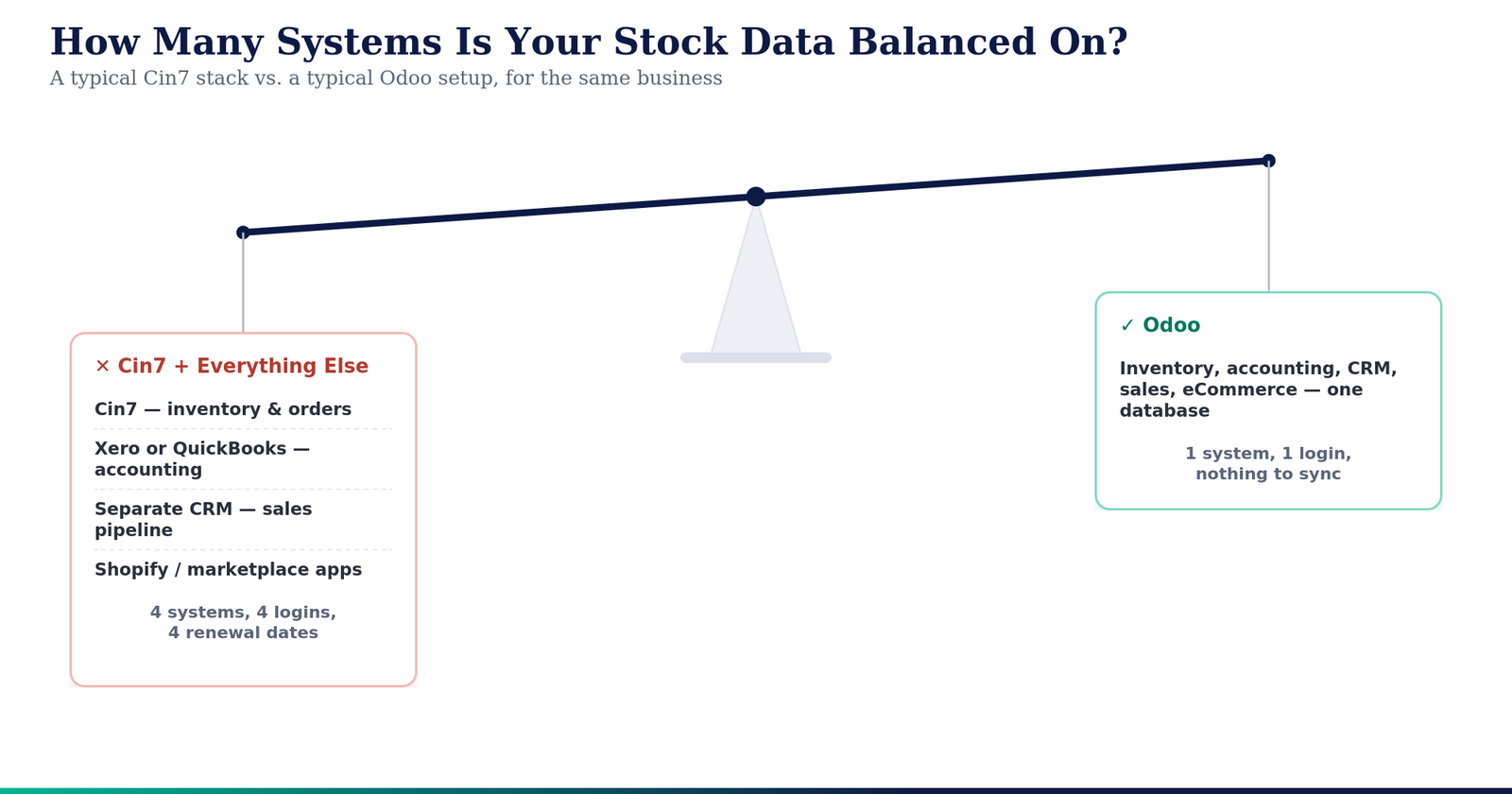
Cin7 is, by its own description, an inventory management system, not an ERP. It doesn’t include a general ledger, doesn’t do bank reconciliation, and doesn’t generate financial statements. It connects to Xero, QuickBooks, or NetSuite for accounting, by design. That’s not a criticism. Cin7 is purpose-built for inventory management, and it does that exceptionally well. For many growing businesses, Cin7 forms the inventory layer of a broader technology stack that also includes accounting software and, often, a CRM.
Odoo takes the opposite architectural approach. Inventory, accounting, CRM, sales, purchasing, and manufacturing are modules inside one platform, sharing one database. When a sales order is confirmed, it doesn’t get synced to inventory, it’s already there, because it’s the same record. When stock moves, the accounting entry doesn’t wait for an integration to run, it exists the moment the transfer is posted. This is genuinely the biggest, most consequential difference between the two products, and it’s also the one a feature-by-feature table is worst at showing, because “accounting integration: yes” looks identical whether that integration is a live sync between two databases or a single shared one.
Where This Plays Out for Inventory and Logistics Businesses
None of this is unique to any one client of ours, it’s the same architectural pattern that shows up across most Australian wholesalers, manufacturers, and distributors at a certain point in their growth. A few illustrative examples of what that looks like in practice:
Illustrative example — multi-warehouse distributor
Picture a distributor running three warehouses, with stock levels tracked in an inventory tool and the general ledger sitting in separate accounting software. Every stock transfer between warehouses eventually needs to show up correctly in both places. On a synced setup, someone is periodically checking that the two agree. On a single connected system, there’s nothing to check, because the warehouse transfer and the accounting entry are the same record.
Illustrative example — 3PL and fulfilment-heavy retailer
Picture a retailer shipping through a mix of in-house warehousing and third-party fulfilment centres. Cin7’s strength here is real: its 3PL and marketplace connectors are purpose-built for exactly this kind of multi-location visibility. The trade-off shows up later, when that same retailer wants a sales rep to see live stock while quoting a wholesale customer, and realises stock, quoting, and fulfilment are now three different logins to check before answering one question.
Illustrative example — wholesale business selling B2B and online
Picture a wholesaler taking bulk orders from retail customers alongside a smaller direct-to-consumer online store. Inventory needs to reflect both channels in real time, or one channel oversells while the other shows phantom stock. Where the inventory, sales order, and invoice are the same record rather than three synced ones, that kind of channel conflict has nowhere to hide, because there’s only one number for stock on hand, not three slightly different ones.
A 5-Question Framework to Decide Between Odoo and Cin7
With the architecture and the examples above in mind, here’s how to apply that to your own business. Five questions, not another feature table:
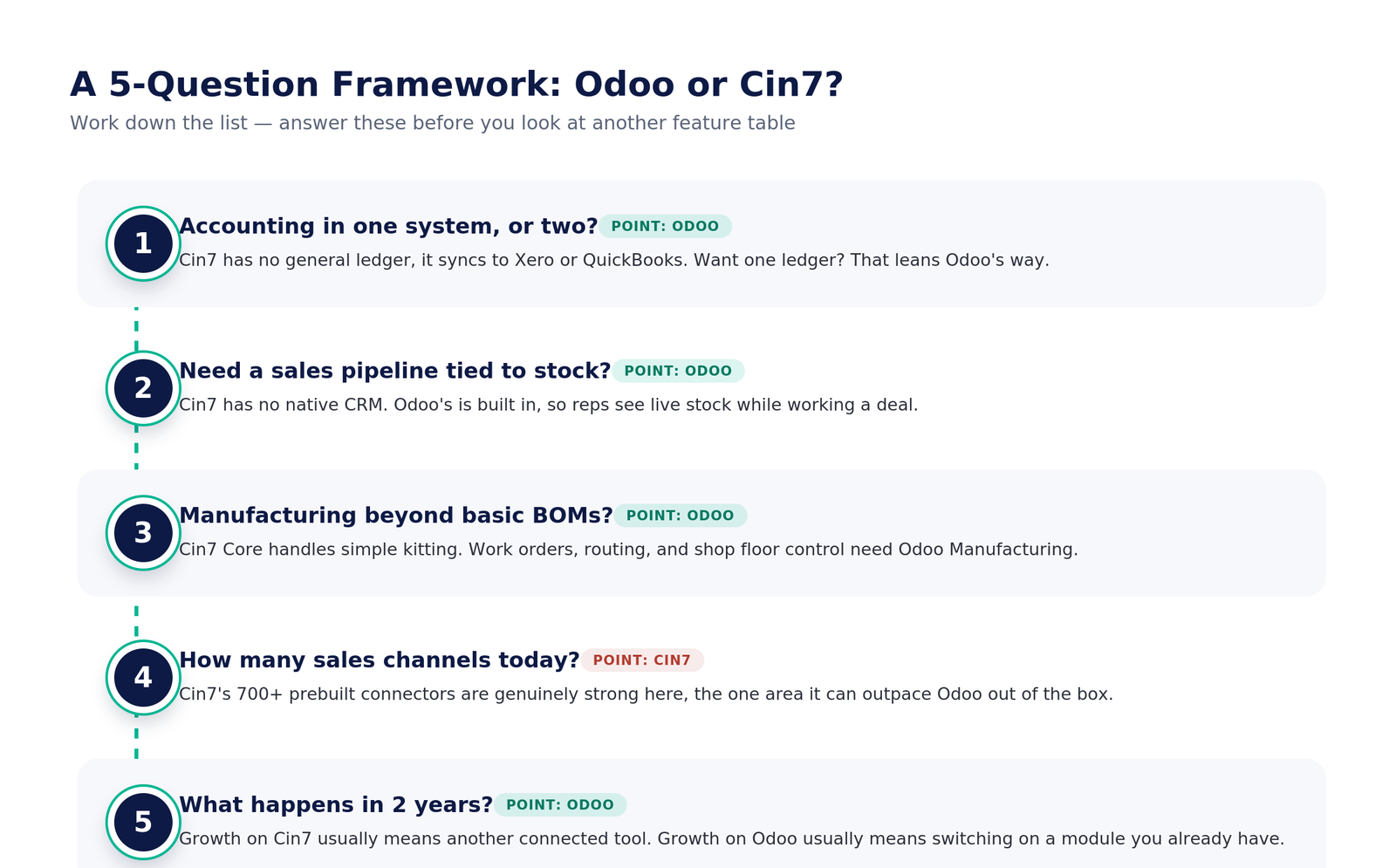
1. Do You Want Accounting in the Same System as Inventory, or Are You Fine Syncing Two?
If your finance team is comfortable with Xero or QuickBooks and just wants clean inventory data flowing into it, Cin7’s sync model works and plenty of businesses run it successfully for years. If you’d rather not reconcile two systems, or you’re finding that reconciliation already eats real time each month, that’s a genuine point in Odoo’s favour, because there’s nothing to reconcile when Accounting and inventory live in one ledger.
2. Do You Have, or Want, a Sales Pipeline Connected to Your Stock Data?
Cin7 has no native CRM. If your sales process is simple, order comes in, order gets fulfilled, that’s not a gap you’ll notice. If you have a sales team actively working leads and quotes who’d benefit from seeing real stock levels while they’re on a call, that’s a third system to add on Cin7, and one that’s already built in on Odoo.
3. Are You Doing, or Planning, Manufacturing Beyond Basic Kitting or BOMs?
Cin7 Core handles simple bills of materials and basic assembly competently. If your production involves work orders, routing between work centres, shop floor tracking, or multi-level BOMs with labour and overhead costing, that’s Odoo Manufacturing territory. Businesses that start with simple kitting and grow into real manufacturing tend to hit this ceiling within a couple of years.
4. How Many Sales Channels Are You Actually Running Today?
This is the one question where Cin7 has a genuine, current advantage. Its marketplace and channel integrations are deep and mature, built by a team whose entire product focus is inventory and multichannel sync. If you’re selling across five or more marketplaces right now, that specialization is real and worth weighing seriously.
5. What Happens in Two Years If You Add a Warehouse, a Product Line, or a New Entity?
This is the question most businesses skip because it’s about a future that feels hypothetical when you’re choosing software today. But growth on Cin7 typically means adding another connected tool, a CRM here, an EDI connector there. Growth on Odoo typically means switching on a module you’re already licensed to use, inside the same database you’re already running.
What This Means for Total Cost, Not Just Sticker Price
Cin7 Core’s published pricing starts at $349 a month, which reads as cheaper than an Odoo implementation when you look at it in isolation. The honest comparison isn’t Cin7 alone versus Odoo alone, though, it’s Cin7 plus whatever accounting platform you’re syncing to, plus a CRM if you need one, versus a single Odoo subscription covering all three. That total often looks quite different once every subscription in the Cin7 stack is added up, especially two or three years in when usage and user counts have grown across every tool in that stack rather than just one. If accounting specifically is your main sticking point, our Odoo vs MYOB comparison covers that side of the decision in more depth.
Read our latest blog : Before AI, Build the Right Foundation: Why Odoo ERP Is Worth the Investment
When Cin7 Is Genuinely the Right Call
If you’re a straightforward product business selling across several marketplaces, your accounting needs are simple, you don’t need a CRM, and you’re not manufacturing anything more complex than a kit, Cin7 plus Xero is a sensible, well-tested combination. It’s genuinely faster to get running for that specific use case, and its marketplace integrations are hard to beat if channel sync is your primary pain point. There’s no need to switch platforms just because a full ERP exists; switching disruption is real, and it should be justified by an actual gap, not by the existence of a bigger product.
When Odoo Is the Stronger Long-Term Fit
If you answered yes to two or more of the five questions above, accounting in one place, CRM connected to stock, real manufacturing, or a genuine expectation of adding complexity in the next couple of years, Odoo’s architecture starts working in your favour rather than against you. This is the pattern we see most often with Australian distributors and manufacturers specifically: the businesses that get the most value from switching are usually the ones already running three or more disconnected systems and feeling the reconciliation overhead, not businesses making a purely speculative move. Our Manufacturing and Distribution solutions page covers what that transition actually looks like.
Still not sure? Still unsure whether your business is better suited to Cin7 or Odoo? We can assess your current systems and recommend the right approach based on your actual workflows, not a generic software demo. Book a free consultation. |
Conclusion
Odoo vs Cin7 isn’t a question a feature table can answer, because both products are genuinely capable within their category. The more useful question is architectural: do you want inventory, accounting, sales, and manufacturing to live in one connected system, or are you comfortable running a specialist inventory tool alongside separate accounting and sales software indefinitely? Answer the five questions above honestly, and the choice tends to become obvious well before you get to comparing individual features.
Ready to dig into the specifics? Our team can walk through your current systems and map out exactly what a switch, or staying put, would involve. Get in touch whenever you’re ready.