Getting Straight to It: Odoo vs MYOB at a Glance
It’s 4:40pm on a Friday. A customer places a decent sized order, mixed products and needs it out the door by Monday. Nothing unusual about that but this single order is a useful test for any Odoo vs MYOB decision, because it quietly exposes something most software comparisons never quite capture: whether your ERP can carry an order from quote to delivery, or whether it can only carry the accounting piece.
If you’re comparing the two right now, you probably don’t want six pages of theory before you get an answer. So here it is, up front.
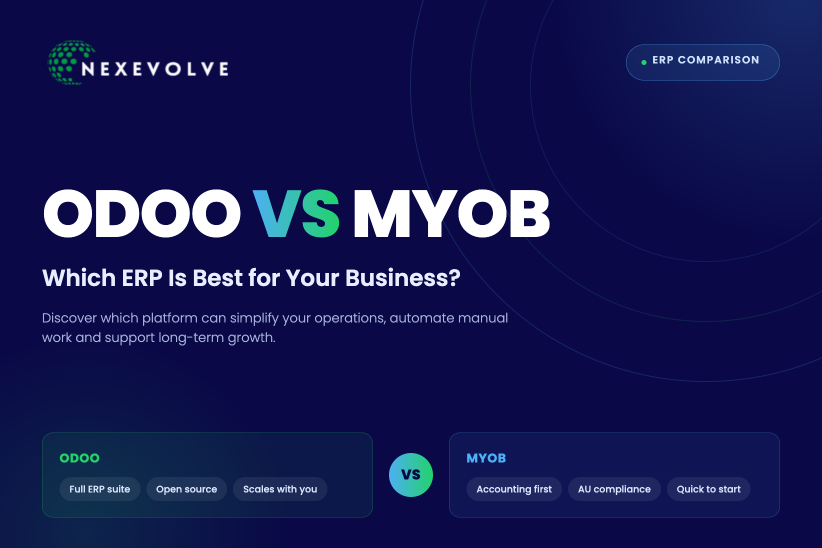
Quick Answer Odoo is a single connected platform covering sales, inventory, manufacturing, and accounting. MYOB is a specialist accounting and payroll tool. If your business is genuinely just accounting and payroll, MYOB remains an excellent, mature choice. If you carry stock, sell across more than one channel, or need sales and operations connected to finance in real time, Odoo is generally the stronger long-term fit. |
What a Friday Afternoon Order Reveals
A single order like this touches five different jobs: sales, stock, fulfillment, invoicing, and once it’s confirmed the reporting that traces back to it. MYOB was built to do one of those five exceptionally well: accounting. It was never designed to run the other four.
In Odoo, the order lands as a quotation in Sales, with stock availability visible on the same screen as a real number, already accounting for what’s reserved and what’s inbound. The moment the quotation is confirmed, a delivery order appears in Inventory and an invoice appears in Accounting automatically, because it’s the same underlying record viewed from three different apps, not three separate records someone has to keep in sync by hand.
One order, one system. Nobody has to remember to check a second place, because there isn’t one. That’s the entire Odoo vs MYOB case in miniature; everything below is really just an expansion of this one scenario.
The reason this matters goes deeper than any single order, though. It comes down to how each platform is architected underneath the surface.
Why Odoo vs MYOB Is More Than a Feature Comparison
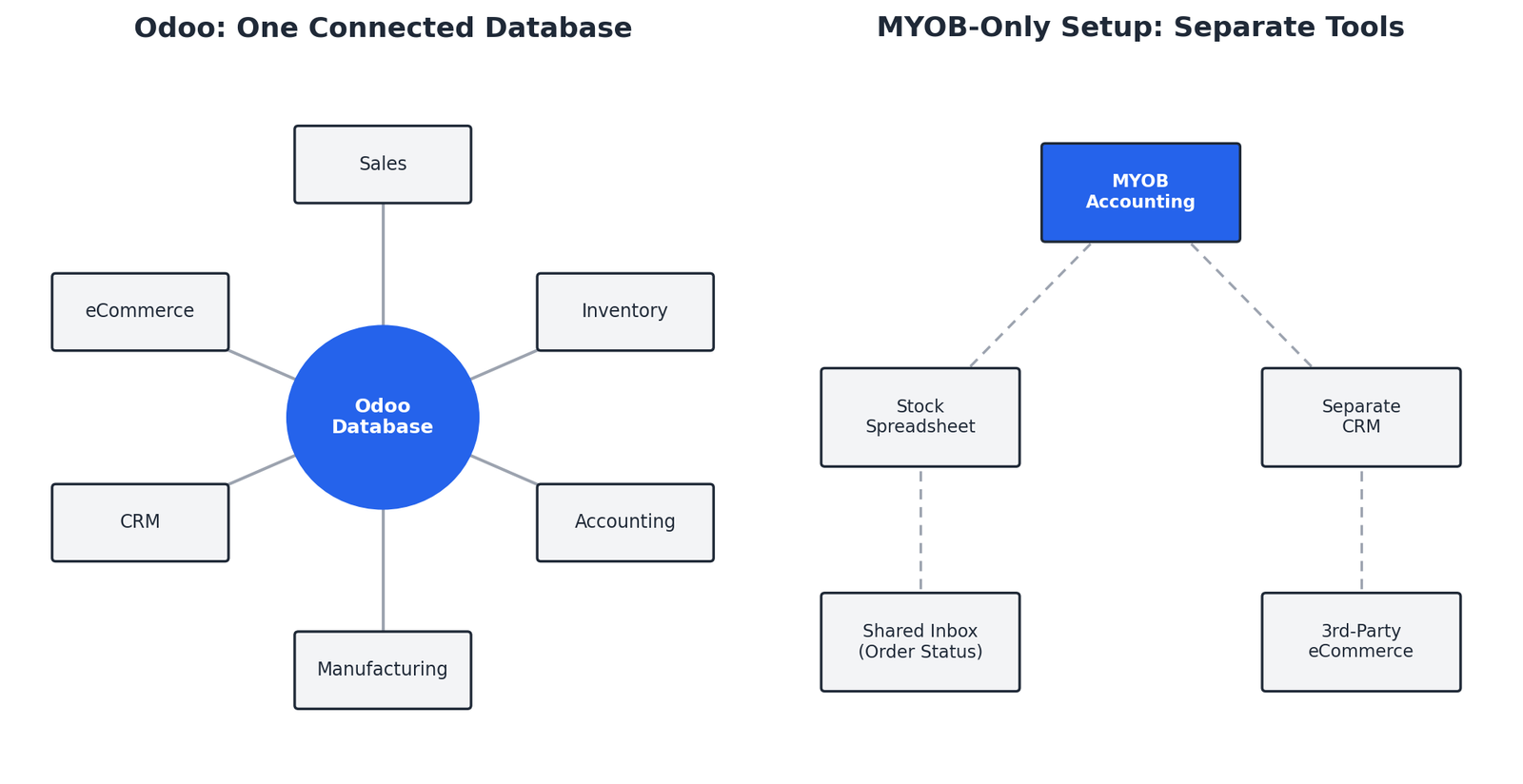
Most Odoo vs MYOB comparisons default to a module checklist: CRM, yes; Inventory, yes; Manufacturing, yes. All true, but it undersells what’s actually going on. The advantage isn’t that Odoo happens to include a CRM app, an inventory app, and an accounting app. It’s that they’re the same data, viewed from different angles, moving through the business as one continuous thread rather than several tools someone has to keep synchronised by hand.
It helps to think of it as operational velocity, how quickly your systems can absorb a change in the business, rather than how many boxes they tick on day one. A platform built on a single shared database moves at the speed of the business itself. A platform built as a compliance-first accounting core, with everything else bolted on afterward, moves at the speed of its slowest stitch. That’s not a knock on MYOB stitching things together was simply never its job.
Judged purely on business outcomes rather than feature counts, the difference shows up as fewer re-keyed numbers, faster month-end close, and a warehouse team that never has to ask sales what actually got promised.
Where Odoo Delivers the Biggest Business Benefits
- Inventory that means what it says: Odoo tracks stock across multiple warehouses, reserves it against confirmed orders, and factors in what’s inbound, so “in stock” is a live answer rather than a number updated once a week.
- A sales pipeline that isn’t a side project: Leads, quotes, and won deals live in the same system as the invoice; they become no export-import step between winning a deal and shipping it.
- Manufacturing, when you need it: Bills of materials, work orders, and quality checks are native- a category MYOB was never positioned to cover.
- Genuine modularity: A business can start with CRM, accounting, and inventory, then add eCommerce, POS, or manufacturing later, without re-platforming.
- Customisation beyond a support ticket: A good implementation partner can build custom fields, workflows, and approval chains directly into the system’s logic, keeping your total cost of change low over time.
- Deployment on your terms: Cloud, self-hosted, or hybrid. Businesses with specific data residency or infrastructure needs can design around their own constraints, not the vendors.
Odoo vs MYOB Feature Comparison Table
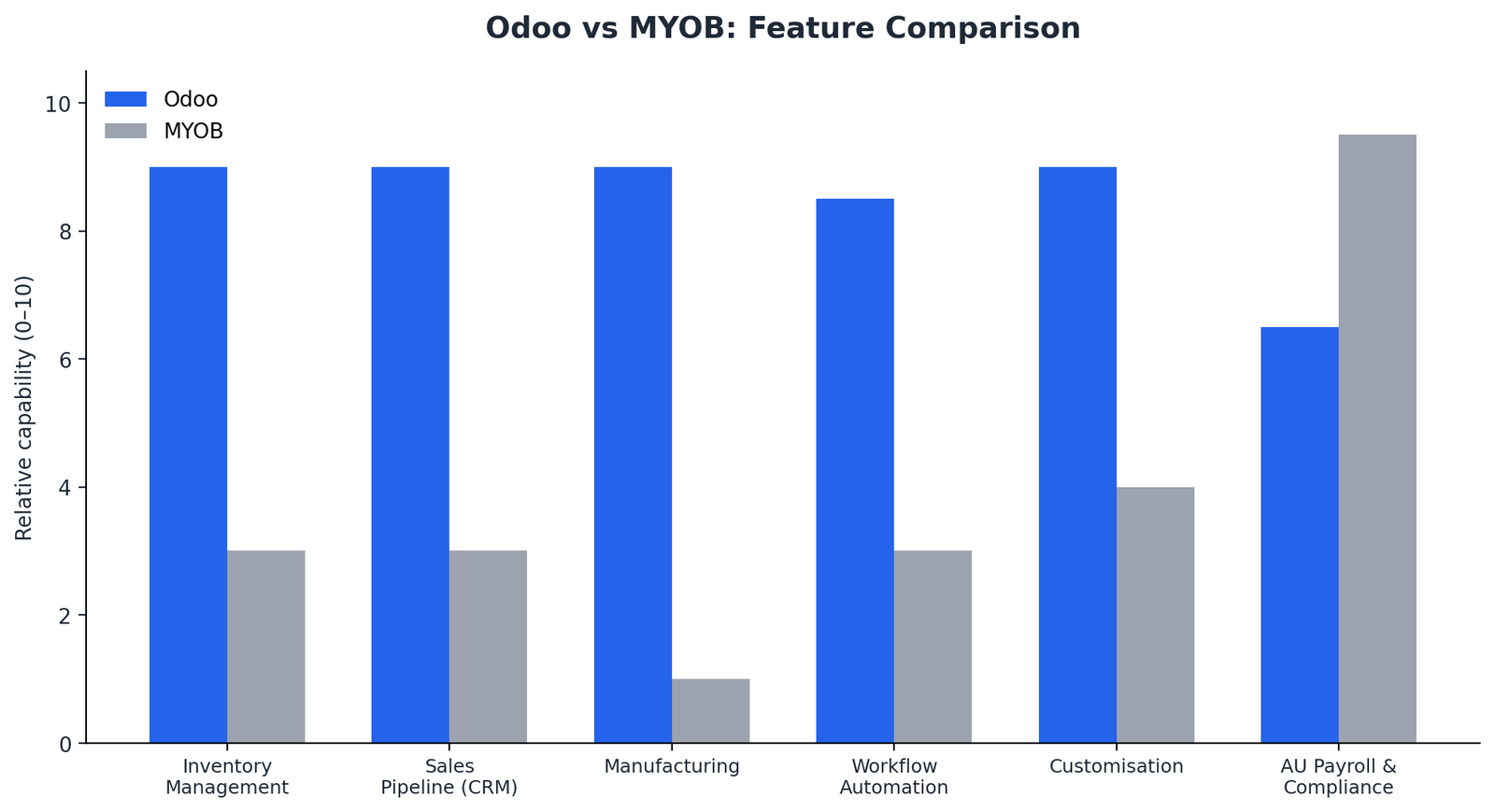
| Capability | Odoo | MYOB |
| CRM & sales pipeline | Native, built in | Limited, or a third-party add-on |
| Inventory management | Advanced (multi-warehouse, barcode, lot tracking) | Basic |
| Manufacturing (MRP) | Native | Not available |
| eCommerce & POS | Native, same database as accounting | Requires third-party integration |
| Workflow automation | Extensive | Limited |
| Customisation | High — partner-led, no-code plus backend | Moderate, more restrictive |
| Australian payroll & compliance | Good, and improving quickly | Excellent, deeply established |
| Deployment options | Cloud, self-hosted, or hybrid | Cloud-only (MYOB Business / Advanced) |
| Single connected database | Yes | No — accounting core with separate tools |
The comparison isn’t close in some rows, and it isn’t meant to be. MYOB’s payroll row is genuinely excellent — that’s the platform doing exactly what it was built for. The rows where Odoo pulls ahead simply sit outside MYOB’s original scope entirely.
Which Businesses Should Choose Which?
Choose MYOB if: your business is essentially an accounting-and-payroll operation, you carry no inventory, you don’t run a sales pipeline that needs to connect to fulfilment, and Australian payroll compliance is your main operational complexity.
Choose Odoo if: you carry stock, sell across more than one channel, manufacture anything, run a sales team that needs visibility into fulfilment, or need finance, operations, and customer data connected in real time rather than reconciled at month-end.
Also read our latest blog: Multi-Level Production Orders in Odoo Manufacturing: The Complete BOM Management Guide
The Hidden Cost of Disconnected Systems
A Real Growth Scenario
Consider a mid-sized Australian homewares distributor running MYOB for accounting, a spreadsheet for stock, and a separate CRM for sales. Business is good, good enough that within eighteen months, the owner opens a second warehouse and launches a Shopify store to reach customers directly.
Neither move is unusual. But in an MYOB-only setup, each one is a new project. The second warehouse means stock now has to be tracked across two spreadsheets, with someone manually deciding which location should fulfil each order. The Shopify store needs its own connector back into accounting and its own stock sync, often lagging by hours, with its own reconciliation at month-end.
In Odoo, both moves are configuration changes rather than re-architecture. The system already understands multi-location stock, so a second warehouse simply means routing and reserving across two locations instead of one. eCommerce is another app on the same database where an order placed online reserves the same stock, hits the same accounting, and lands in the same fulfillment queue as an order taken over the phone. The difference isn’t that MYOB can’t be connected to a warehouse system or an online store, it can through integrations. The difference is whether that connection is a new project every time, or something the platform already does natively.
The Costs That Never Show Up on an Invoice
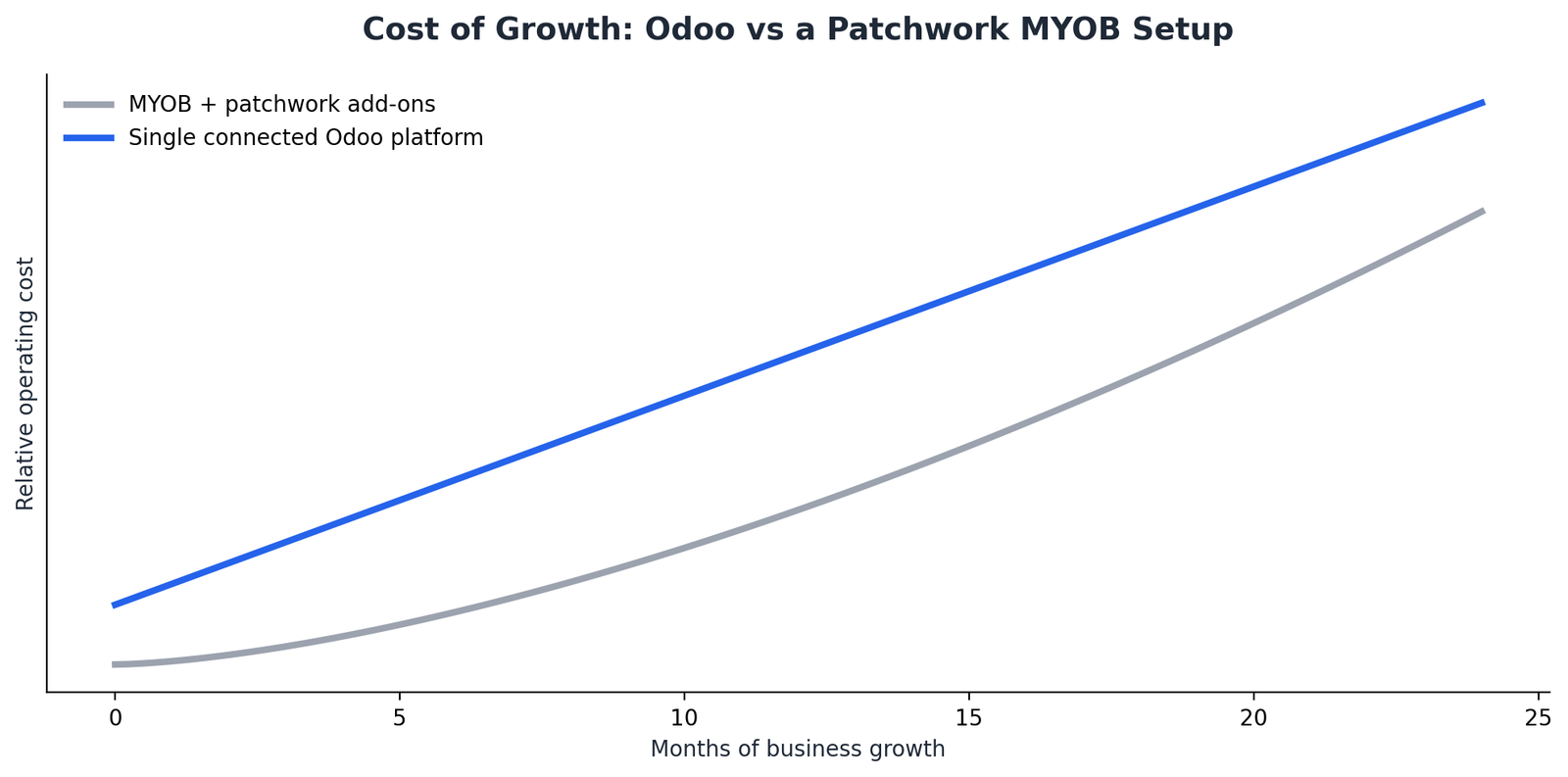
When a business runs accounting on MYOB and everything else on whatever’s nearby, a second, unofficial system tends to grow up quietly around it. Not because MYOB failed, but because it was never meant to carry that weight.
- Time cost: Usually one person ends up holding the whole patchwork together re-keying data, cross-checking stock against a spreadsheet, chasing the current version of a customer record.
- Data integrity cost: Every manual handoff is a point where numbers can quietly diverge, surfacing months later as a stocktake that doesn’t reconcile or a customer billed the wrong price.
- Growth ceiling cost: A patchwork can carry a small team fine, but not a business that’s doubled in size or added a channel not without adding more people just to hold the gaps together.
- Opportunity cost: Every hour spent reconciling two versions of the truth is an hour not spent serving the next customer or improving the process itself.
Thinking About ROI: What Switching Actually Buys You
The ROI case for Odoo isn’t really that it’s cheaper per seat, though it often is. It’s that the job one person is currently doing by hand reconciling stock, chasing order status, re-keying invoices is a job a single connected platform does automatically.
When you model the business case, weigh the cost of the migration against the fully loaded cost of the person or people currently holding the patchwork together, plus the growth the business can’t yet see because the team is busy reconciling instead of selling. Most Australian businesses that make the move recover the cost within the first one to two operating cycles, simply by removing the manual reconciliation layer.
A Realistic Migration Roadmap
- Discovery and scoping: Map current workflows across sales, stock, and finance, and identify which spreadsheets and side-systems are quietly load-bearing.
- Data migration: Move the chart of accounts, contacts, open invoices, and transaction history across cleanly, with reconciliation checkpoints along the way.
- Process design and configuration: Configure Odoo’s modules inventory, sales, manufacturing, accounting around how the business actually operates, not a generic template.
- Localisation: Set up Australian GST, BAS reporting, and STP Phase 2 payroll alongside local bank feeds.
- Training and go-live: Get the team comfortable in the new system before the old one is switched off, with a defined cutover date.
- Post-go-live support: Monitor the first few reporting cycles closely, since this is when gaps in configuration usually surface.
This is the part where the right Odoo implementation partner earns their fee not by installing software, but by making sure the rollout sticks instead of becoming its own patchwork. We’ve run this roadmap with Australian distributors, manufacturers, and retailers moving off MYOB, and the projects that go smoothly are almost always the ones where discovery was done properly before a single module was configured.
Key Takeaways
- MYOB was built to do accounting and payroll extremely well, this isn’t about it failing at order fulfilment, since that was never its job.
- The real issue is scope: a modern order touches sales, stock, fulfilment, invoicing, and reporting five functions MYOB was never positioned to unify.
- Odoo’s advantage is a single shared database that runs all five as one connected process, not a longer feature list.
- The cost of stitching disconnected systems together shows up as time, data errors, a growth ceiling, and lost opportunities rarely as a line item.
- A structured migration roadmap, done properly, is what separates an Odoo rollout that sticks from one that becomes its own patchwork.
If that Friday-afternoon order sounds familiar, the next step isn’t a sales pitch. It’s a conversation about your current workflow and where the gaps actually are.
We help Australian businesses move from MYOB to Odoo properly from discovery through to go-live. Explore our Odoo implementation services, browse our Odoo case studies from other Australian businesses, or get in touch with our team for a discovery call.