By the Nexevolve team – Odoo Silver Partner, Australia
Choosing the right ERP software Australia looks simple from the outside and gets complicated fast once you start comparing vendors. Every provider claims to fit your industry and pay for itself within a year, it really comes down to how your business runs, not how good the demo looks.
We have sat on both sides of this decision, helping Australian businesses choose ERP software and watching what happens when the wrong system gets picked anyway. This guide covers what genuinely matters, the systems most businesses shortlist, implementation, cost and the mistakes worth avoiding.
10 Things to Consider When Choosing ERP Software in Australia
Not every point carries equal weight for your business, but skipping one tends to surface as a problem six to twelve months after go-live, once it’s expensive to fix. Treat this as a working checklist against your own shortlist.
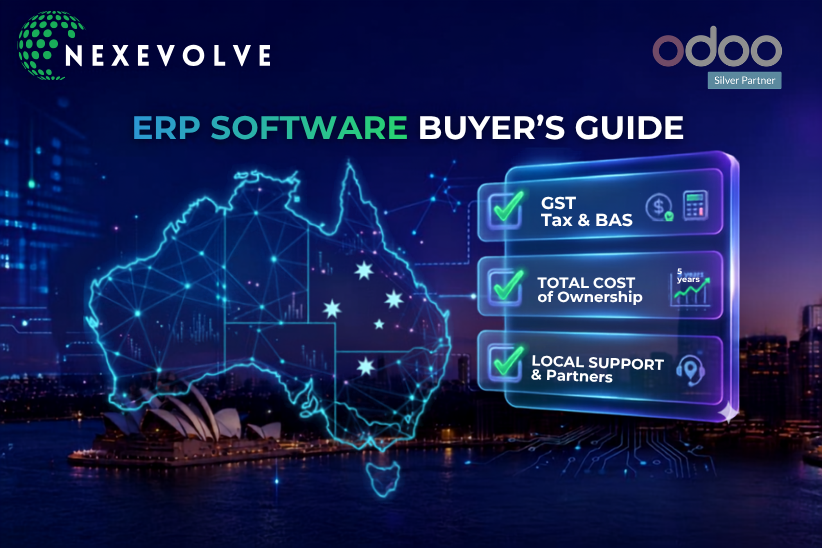
- Total Cost of Ownership, Not Just the License Price
The license fee is easy to compare, but real cost includes implementation, migration, training and support, often two to three times the license cost in year one. Ask for a five-year total, not a monthly quote. - Fit for Australian Tax and Payroll Compliance
A system built for the US or UK market often treats GST, BAS reporting and Single Touch Payroll as an afterthought. Confirm it handles Australian requirements natively, not via a workaround that breaks with every ATO update. - Industry and Business Size Fit
A platform built for large enterprise manufacturers rarely suits a twenty-person distributor and the reverse is just as true. Ask for references your own size, in your own industry. - Cloud vs On-Premise Deployment
Cloud ERP suits most Australian businesses, with lower upfront cost and less reliance on internal IT. Some regulated or manufacturing-heavy operations still have valid reasons for on-premise deployment. - Integration With the Tools You Already Use
Check how well the ERP integrates with the accounting, eCommerce, CRM or point-of-sale tools you’re keeping and ask specifically about open API access rather than a vague “yes, it integrates”. - Scalability as You Grow
The system handling fifteen staff needs to still work at fifty, without a costly re-implementation in between. Ask what breaks first and what it costs to fix.
If scalability is a live concern, our piece on scaling a business without hiring covers this in more depth. - Local Implementation and Support
An overseas support desk in a different time zone is a real problem the first time your system goes down mid-shift. Prioritise a local partner reachable during business hours. - Data Security and Backup Standards
Ask exactly where your data is hosted, how often it’s backed up, and what disaster recovery looks like. “Enterprise-grade security” is a marketing phrase, ask for specifics. - User Experience and Staff Adoption
The most capable system is worthless if your team quietly avoids it because it’s clunky. Involve daily users in the demo, not just management. - Vendor Track Record and References
Ask for three references similar to yours in size and industry, not just case studies on the vendor’s website. A confident vendor will connect you directly.
The ERP Systems Most Australian Businesses Compare
Most Australian shortlists narrow to the same handful of names. Here’s a quick, at-a-glance comparison of where each tends to fit:
| ERP System | Best Fit For | Key Advantage | Main Trade-off |
| Odoo | Growing SMBs wanting unified operations and finance | Highly customisable, open-source, all-in-one platform | Needs a qualified local partner for custom setups |
| NetSuite | Multi-entity, enterprise-scale businesses | Deep financial reporting and multi-currency consolidation | High licensing costs; script-heavy customisation |
| Dynamics 365 | Microsoft-centric organisations | Seamless integration with Outlook, Excel and Power BI | Inventory and warehouse features often need costly add-ons |
| SAP Business One | Established manufacturers and distributors | Strong, pre-standardised process discipline | Rigid structure; hard to bend around non-standard workflows |
| MYOB Acumatica | Businesses upgrading from MYOB needing local tax compliance | Native Australian tax, BAS and STP compliance built in | Smaller partner network than the global platforms above |
One more worth watching for: a niche, industry-specific system that fits your exact vertical perfectly today, often held by a small vendor with a closed database. Before signing, get a straight answer on what happens to your records if that vendor is acquired or stops investing.
How to Compare ERP Vendors Properly
A table like this is a starting point, not the decision. Shortlist three or four systems on fit, then run the same evaluation against all of them:
- Score against your own criteria – write down the ten points above before the first demo, and score every vendor against the same list.
- Request the same demo script – have every vendor demonstrate the same real workflows, using your own sample data where possible.
- Separate the platform from the partner – the same ERP can succeed or fail depending on who implements it, so evaluate the local team too.
- Get a like-for-like cost estimate – the same five-year total-cost request, in writing, from every vendor on the shortlist.
ERP Implementation in Australia
Implementation is where most project risk actually sits, not in choosing the software. A typical rollout moves through five phases: discovery, configuration, data migration, testing and training, then go-live with a short period of hands-on support.
Timing depends less on the software than on how clean your data is and how fast your business can decide. A single-entity rollout can go live in eight to ten weeks; a multi-warehouse rollout more realistically takes five to seven months, and a genuinely complex implementation can run nine months or more.
Rushing this stage to hit an arbitrary deadline is a common way a sound choice of ERP software in Australia turns into a difficult rollout; the platform gets blamed for problems caused by compressed testing and training.
Read our Latest Blog – Odoo AI Agents for your Business.
What Does ERP Software Cost in Australia?
The license fee is only part of the answer, which is why total cost of ownership sits at the top of the checklist above. Roughly, Australian ERP projects fall into three bands:
- Small and straightforward – $30,000 to $60,000, single-entity with limited customisation, live within two to three months.
- Mid-complexity – $70,000 to $120,000, multiple locations or a manufacturing/inventory component, five to seven months to go-live.
- Complex or multi-entity – $150,000 upward, for multi-entity or heavily customised implementations, often nine months or more.
These bands cover implementation, migration and training on top of the license; treat any quote naming only a monthly per-user fee as incomplete until a full project figure is in writing.
Questions to Ask During an ERP Demo
A good demo is rehearsed, which is exactly why it’s worth pushing past the rehearsed part. A few questions surface what a standard demo won’t:
- Can you run this exact workflow using our own sample data, not prepared demo data?
- Which parts are out of the box and which were custom-built for this pitch?
- Who actually implements this: your team or a subcontracted partner we haven’t met?
- What breaks or gets more expensive if we add a warehouse or 20 more users next year?
- Can we speak directly with a reference customer who has lived on this for twelve-plus months?
Common ERP Selection Mistakes
Most ERP regrets trace back to one of a handful of avoidable mistakes:
- Choosing on features, not fit – the most feature-rich platform often becomes the least-used system if it doesn’t match how the business operates.
- Skipping real reference checks – a polished case study isn’t the same as a call with a business running the system today.
- Underestimating total cost – budgeting against the license fee alone, then being surprised by costs two to three times higher.
- Rushing under sales pressure – an end-of-quarter discount rarely justifies skipping a proper comparison.
Why Getting This Right Matters
Getting this decision right pays off well beyond go-live day: the system fits how you already operate, rather than forcing a rebuild of every process around its limits. Get it wrong, and workarounds pile up and staff lose confidence in the numbers. We have seen businesses spend more fixing a poorly chosen ERP system than choosing the right one from the start would have cost.
What This Looks Like in Practice
The following is illustrative of a pattern we see often, not a named case study.
Before: A mid-sized Australian distributor running on spreadsheets, disconnected accounting software and manual processes stitched together across the warehouse and the front office.
Challenge: Limited visibility into stock across two sites and operational complexity that was starting to outpace what the existing setup could support.
What they evaluated: Three ERP options, run through the same checklist above – total cost of ownership and local support ruled out two of the three before a single demo was even booked.
Outcome: They selected the platform that best matched their size, industry and requirements; not the most feature-complete one on the shortlist and staff were using it properly within the first fortnight. It is the same discipline behind our own Artego wholesale operations case study.
Final Thoughts
There is no single best ERP software Australia businesses should default to only the system that fits your industry, size and the way your team works. Run through these ten points before you commit and be honest about total cost rather than the license price alone.
If you would rather talk it through, our team at Nexevolve can recommend an approach based on your actual setup, including for manufacturing and distribution businesses.
TALK TO NEXEVOLVE → Weighing up which ERP system is the right fit for your business? Nexevolve, an Odoo Silver Partner in Australia, can assess your setup and recommend the right approach – no generic sales pitch. We can help you assess your current systems, compare suitable ERP options and identify the right implementation approach for your business. |
Choosing usually takes four to eight weeks when comparing three or four vendors, including demos and reference checks. Implementation varies by complexity, but a straightforward mid-market rollout typically takes two to four months from signing to go-live, while a multi-entity or manufacturing-heavy project can run considerably longer.
Cloud ERP is hosted by the vendor and accessed online, with lower upfront cost and automatic updates. On-premise ERP runs on your own servers, giving more control but requiring your own IT infrastructure. Most Australian SMBs now choose cloud for the lower overhead.
Costs vary by vendor and business size, but expect the total first-year cost, including implementation and training, to run well above the advertised license fee alone. Small, straightforward projects often start around $30,000; always ask for a five-year total cost estimate before comparing options.
Accounting software tracks the money; ERP connects inventory, sales, purchasing and operations to that same data in real time. Spreadsheets sitting alongside your accounting software, or duplicate manual entry across systems, is usually the clearest sign that you’ve outgrown it.