
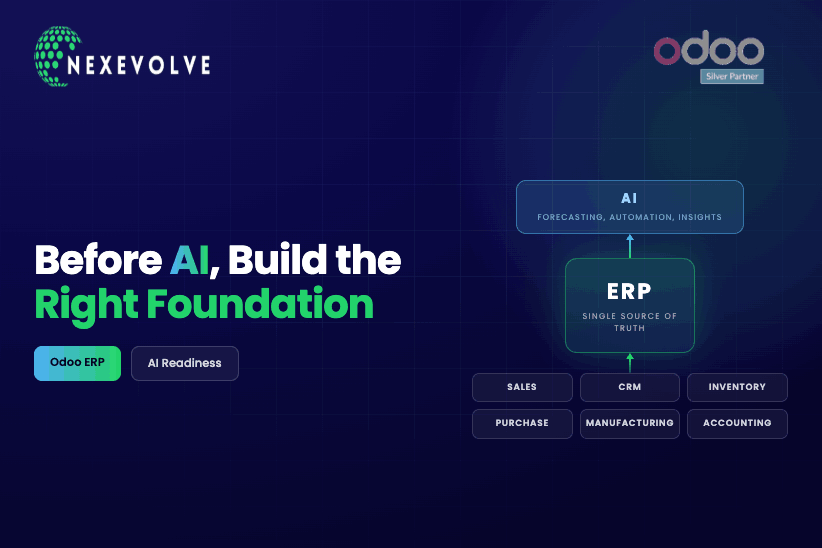
Every business is talking about AI right now. From automated customer service to predictive analytics, organisations are looking for ways to use AI to improve productivity and decision-making. Yet many overlook one critical fact: AI is only as effective as the data behind it.
If your business data is spread across spreadsheets, disconnected applications, and manual processes, AI can’t deliver reliable insights, whatever tool you buy. Before investing in AI, businesses need a connected, structured data foundation. That’s where a modern ERP like Odoo delivers lasting value and it’s also where the “is Odoo ERP worth it” question actually starts.
This guide covers both halves of that question: the operational ROI Odoo ERP delivers on its own, starting now, and why that same foundation is what determines whether AI actually works for your business later.
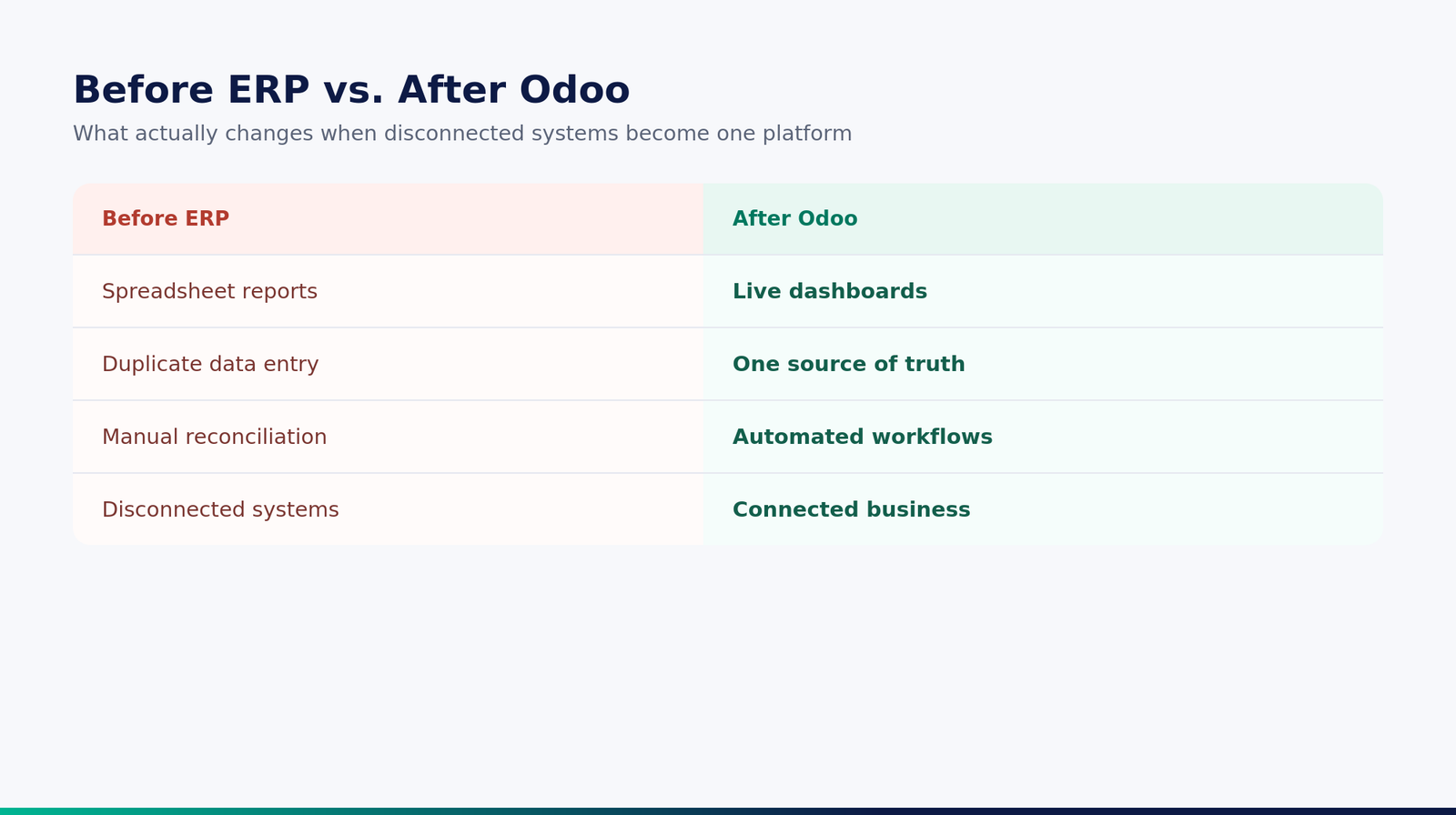
Most Businesses Ask the Wrong Question First
Cost without context is just a number. Odoo ERP ROI reframes the conversation from “what will this cost me” to “what will this get me back, and by when” a far more useful question when deciding whether, and when, to move forward. This isn’t about ignoring cost, it’s about understanding the return first, so the cost becomes a number you can actually evaluate rather than one floating on its own with nothing to weigh it against.
How Odoo ERP Actually Pays for Itself
Odoo ERP ROI comes from a small number of consistent levers, not from the software itself but from what it removes: the manual work that exists purely to bridge disconnected systems. This is the part of the investment that pays back regardless of AI, Odoo delivers ROI today while quietly preparing your business for AI tomorrow, since the same levers below are also what a connected data foundation looks like in practice.
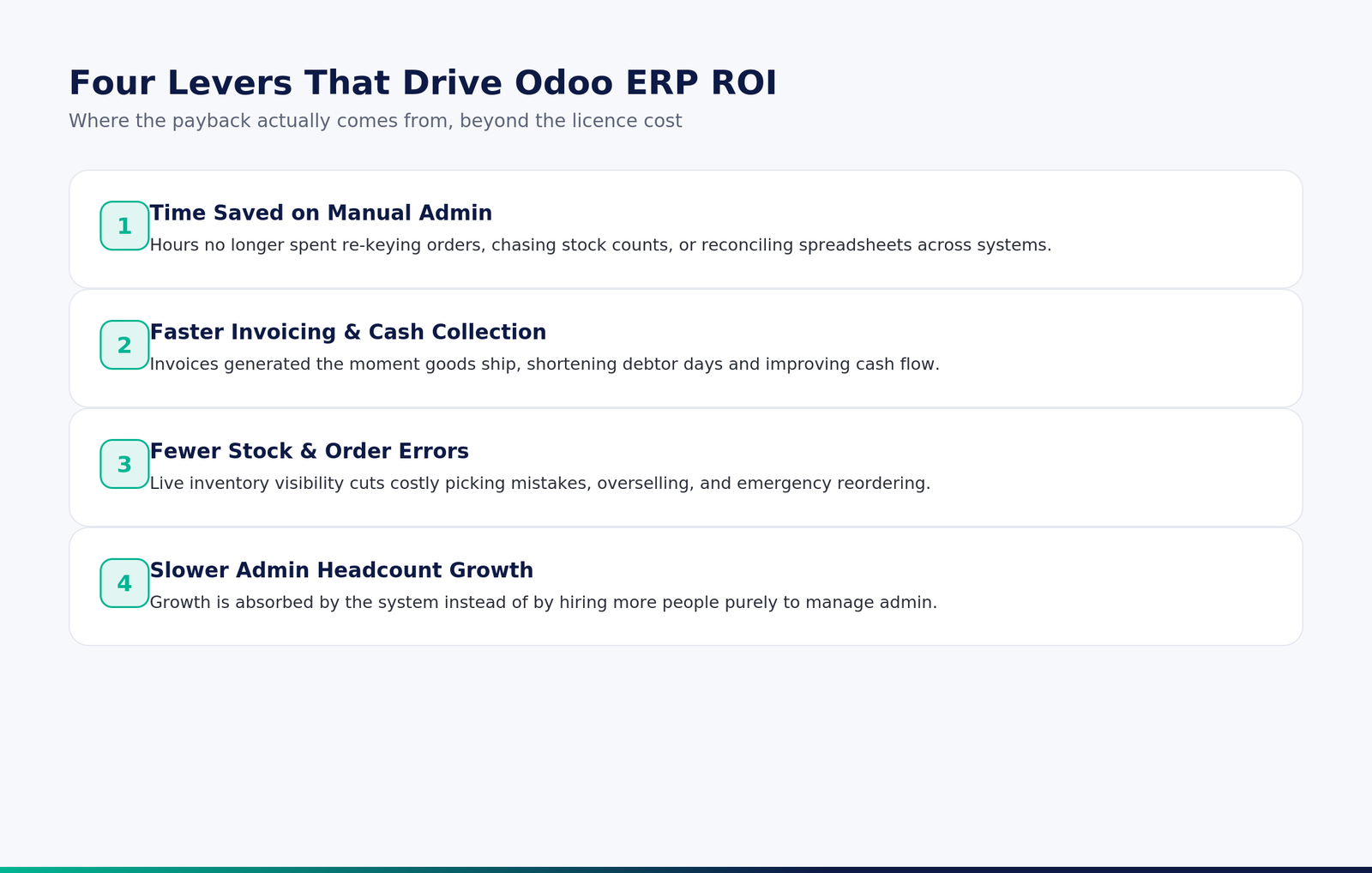
Time Saved on Manual Admin
Every hour staff spend re-entering data, chasing stock counts across a spreadsheet, or manually reconciling numbers between systems is an hour a connected system removes entirely. This is usually the fastest-realised and most visible return.
In practice One of our engineering industry clients saw a 95% reduction in manual tasks after implementing Odoo ERP with Nexevolve across their operations – a concrete example of how much manual work a connected system removes once teams aren’t reconciling data between systems by hand. See our case studies. |
Faster Invoicing and Cash Collection
When an invoice generates automatically the moment goods ship, instead of days later once someone remembers, debtor days shrink. For a business with meaningful revenue, even a modest improvement in collection speed has a direct, measurable cash flow impact.
In practice A food distribution and service client of ours achieved 85% faster sales order efficiency after implementing Odoo ERP with Nexevolve – the kind of speed gain that directly shortens the gap between an order going out and getting invoiced and paid for it. See our case studies. |
Fewer Stock and Order Errors
Live inventory visibility means fewer overselling incidents, fewer picking errors, and less emergency reordering at premium prices. These are costs that rarely appear in a budget line but show up clearly once they stop happening. This same live, accurate stock data is also exactly what demand-forecasting AI would need to be trustworthy rather than confidently wrong.
In practice One of our manufacturing clients reached 98% inventory accuracy after implementing Odoo ERP with Nexevolve – directly addressing the kind of stock discrepancies that trigger overselling and costly emergency reordering. See our case studies. |
Slower Admin Headcount Growth
As a business grows, admin-heavy processes usually demand proportional headcount to keep up. A connected system absorbs a meaningful share of that growth, meaning the business scales without hiring purely to manage manual work.
Where ROI Actually Shows Up
The four levers above play out differently depending on what your business actually does. A few common patterns:
Retail
Stock accuracy across multiple locations or channels is usually the biggest win – fewer “sold out but the system says three in stock” moments, and less manual stocktaking to compensate. It’s also the same accurate, real-time stock data any future AI-driven demand forecasting would depend on.
Manufacturing
ROI tends to concentrate on production planning and materials, fewer stalled jobs waiting on stock that were never actually there, and clearer visibility into true cost per unit.
Wholesale and Distribution
The order-to-cash cycle is where the time and cash flow gains show up fastest: faster picking, faster invoicing, fewer reconciliation hours at month-end. Those same connected order and dispatch records are what a future automated reporting or forecasting layer would need to be reliable.
Professional Services
Time and project billing accuracy drive ROI here — fewer hours quietly written off because they were never captured or invoiced correctly in the first place.
Construction
Project costing and subcontractor tracking tend to deliver the clearest return, since margin visibility on individual jobs is often the thing leadership has the least confidence in beforehand.
Client Spotlight – Global Retail Operations One of our retail and e-commerce clients, a global brand operating across multiple countries and subsidiaries, unified operations onto a single Odoo ERP platform with Nexevolve – reaching 90% more operational visibility across the business. See our case studies. |
How Odoo’s Architecture Specifically Supports Faster ROI
Not every ERP delivers ROI at the same speed, and architecture is a big part of why. Odoo runs sales, inventory, and accounting as views of the same connected record rather than separate modules kept in sync by integrations or manual re-entry. That matters for ROI specifically because much of the return comes from eliminating reconciliation work and there’s less to eliminate when the system was disconnected to begin with.
Odoo’s modular rollout model also supports faster, lower-risk payback. Rather than committing to a single, all-or-nothing go-live, businesses can implement the highest-friction areas first, commonly sales and inventory, start realising savings there, and expand into manufacturing, HR, or additional modules once the first phase has proven its return.
Typical Odoo ERP Payback Timelines in Australia
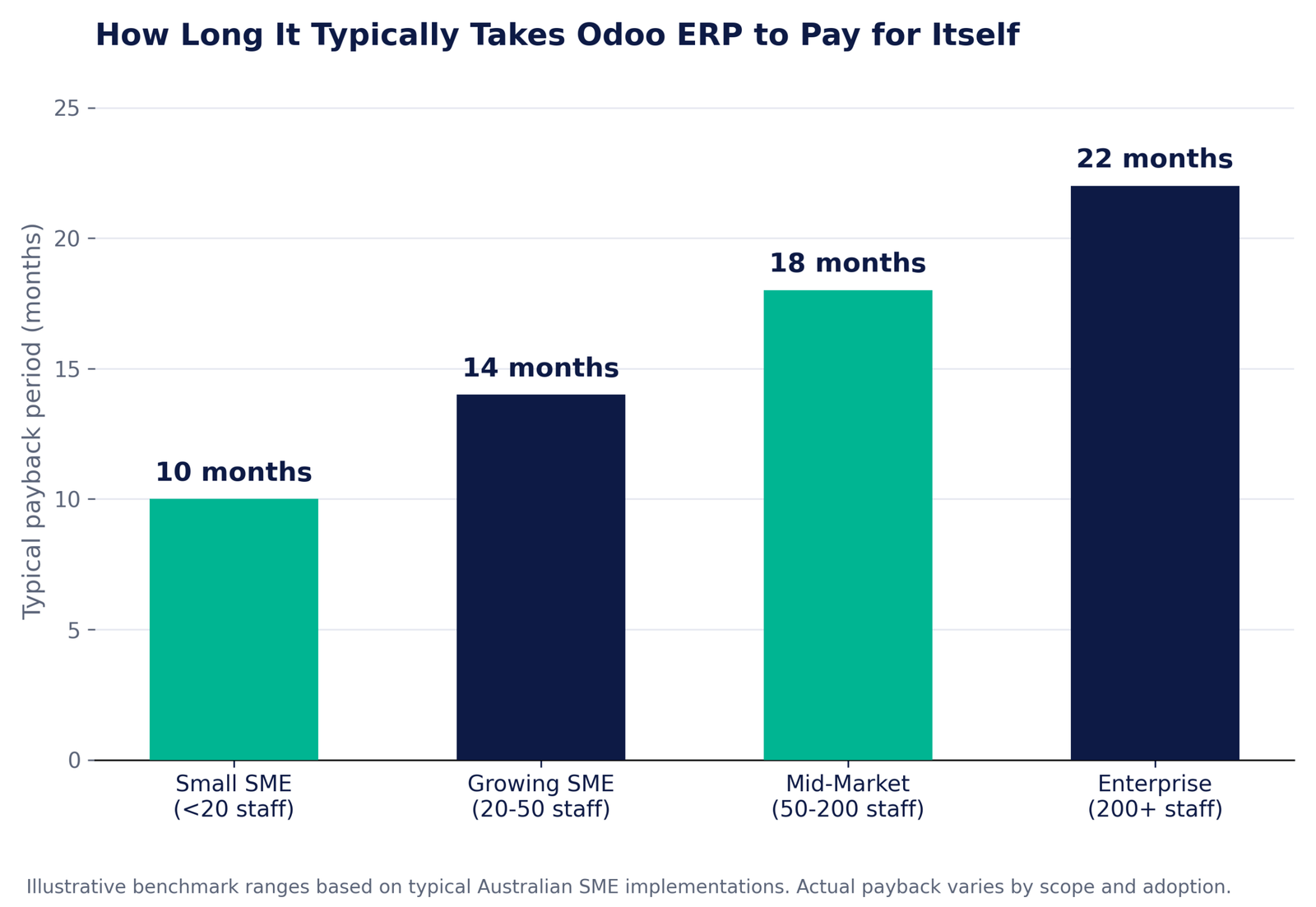
Payback periods vary by business complexity, but a consistent pattern shows up across Australian implementations: smaller, simpler businesses tend to see payback faster, largely because there’s less legacy manual process to unwind and adoption happens more quickly across a smaller team. Larger, more complex implementations take longer to pay back in absolute terms, but often deliver a larger total return once they do.
For a deeper look at how Odoo stacks up against a pure accounting tool, see our latest blog Odoo vs MYOB comparison.
A Simple Framework to Calculate Your Own Odoo ERP ROI
You don’t need a finance degree to get a workable estimate. Four numbers get you most of the way there:
1. Admin time saved | Weekly hours on manual reconciliation × average loaded hourly cost × 52 |
2. Faster cash collection | Reduction in debtor days × average daily revenue |
3. Fewer errors | Estimated annual cost of stock errors, mis-picks, and emergency freight |
4. Avoided hiring | Cost of admin-focused roles no longer needed over the next 12–24 months |
Add those together for an annual return estimate, then compare it against the total implementation cost to get a rough payback period. It won’t be precise, but it will be far more useful than comparing vendor quotes with no reference point for what you’re actually getting back.
Worked Example: Estimating ROI for a Growing Wholesale Business
Consider a wholesale business with 25 staff, currently running MYOB for accounts, a shared spreadsheet for stock, and a separate sales tracking tool. Roughly three staff spend a combined 20 hours a week on manual reconciliation and data re-entry across these systems. At an average loaded cost of $45 an hour, that’s approximately $46,800 a year in admin time alone, before accounting for invoicing delays or stock errors.
If Odoo ERP implementation for this business costs an estimated AUD $70,000 including licensing, configuration, and training, admin time savings alone would recover more than half of that within the first year. Layering in faster invoicing and fewer stock errors, a payback period inside 12 to 15 months becomes realistic, consistent with the benchmark range shown above for a business of this size.
Beyond the Numbers: What Actually Changes for Your Team
The levers above are the ones you can put a dollar figure against. But talk to a leadership team six months after go-live, and the numbers are rarely the first thing they mention. What comes up first is usually softer than that, and it’s still worth naming, because it’s often what actually drives the decision:
Finance and operations work from the same data, eliminating disputes over whose numbers are correct.
Leadership gains real-time visibility into business performance without waiting for manually prepared reports.
Staff spend less time firefighting, reducing the need to chase missing orders, investigate stock discrepancies, or apologise for delayed invoices.
Teams focus on higher-value work instead of repetitive administrative tasks and damage control.
Decision-making becomes faster and more confident, supported by accurate, up-to-date information rather than assumptions or outdated reports.
None of that fits neatly into a payback calculation. But it’s frequently the difference between a business that tolerates its ERP and one that genuinely relies on it. It’s also the difference between a dashboard that just displays numbers and a data foundation an AI tool could eventually build on without a rebuild first.
Common Mistakes That Blow Out ROI Timelines
The businesses that see slower-than-expected ROI usually share a few habits. They under-invest in training, so adoption stays partial and old manual habits persist alongside the new system. They over-customise early, adding cost and complexity before the standard system has been given a fair chance to prove itself. And they skip a proper baseline, so twelve months in, nobody can actually say with confidence how much time or money has been saved, because nobody measured the starting point.
Avoiding these three mistakes does more for your actual ROI timeline than negotiating the implementation fee down by a few thousand dollars. See how we help clients avoid them in our case studies, or explore Nexevolve’s Odoo ERP implementation services.
Why This Also Sets You Up for AI
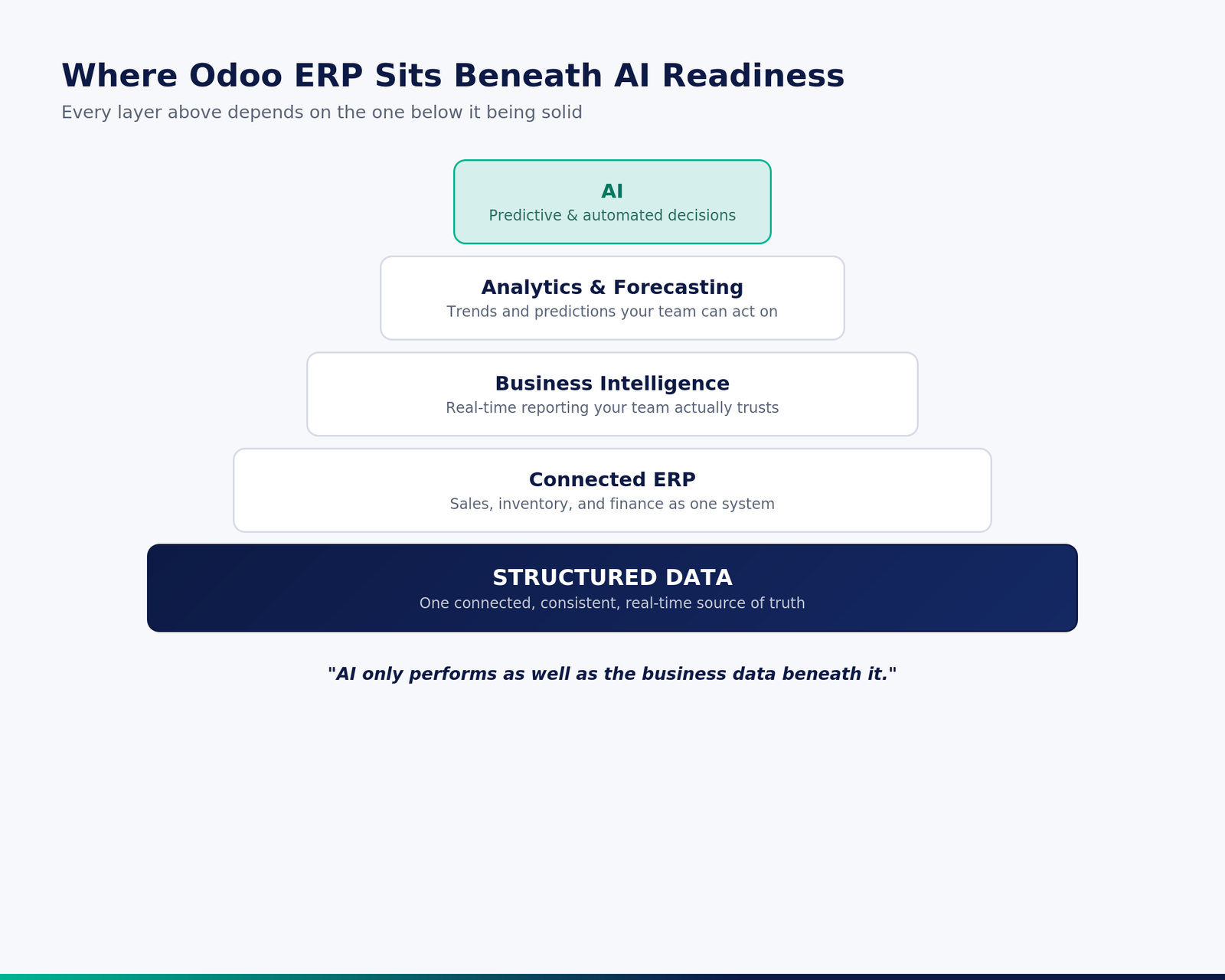
Everything above is true regardless of whether AI is anywhere on your roadmap. But it’s worth naming the bonus: the same connected foundation that delivers this ROI is also what AI needs to be useful later. This isn’t just a reasonable assumption, it’s well documented Gartner predicts that through 2026, organisations will abandon 60% of AI projects that aren’t supported by properly structured, well-governed data. A forecasting model trained on stock numbers that are routinely wrong will forecast confidently and incorrectly, and no amount of AI sophistication fixes that upstream.
Odoo creates that structured foundation by running sales, inventory, and accounting as views of the same connected record, rather than as separate systems kept loosely in sync through exports and manual re-entry. Getting this right isn’t a bet on AI. It’s simply not making a decision now that would need to be undone later if AI does become part of the plan.
Is Your Business Ready for AI?
A quick self-check, regardless of whether AI is on your roadmap yet:
☐ Are sales, inventory, and finance connected in one system? |
☐ Do you trust your inventory numbers without double-checking them? |
☐ Can you access real-time reports without waiting on someone to build them? |
☐ Are manual spreadsheets still filling gaps between your core systems? |
☐ Does your ERP give you a single source of truth across departments? |
If most of those are a “no” right now, that’s not a problem specific to AI, it’s the same gap that’s already costing you time and money today. Fixing it pays for itself on operational grounds alone, and it happens to be the same fix either way.
Conclusion
So, is Odoo ERP worth it? For most Australian businesses running disconnected systems across sales, inventory, and finance, the honest answer is: usually, and often faster than expected, largely because so much of the current cost is invisible- buried in manual admin time, slow invoicing, and preventable errors rather than sitting on any invoice.
But the question worth sitting with isn’t only whether your business will adopt AI, it’s whether your business will be ready for it when it does. By investing in a connected ERP today, you improve efficiency, gain real-time visibility, achieve measurable ROI, and build the structured data foundation that future AI initiatives depend on. Odoo ERP ROI is simply a more useful lens than cost alone, because it answers the question that actually matters: not just what you’ll spend, but what you’ll get back, now and later.
Curious what your own payback period could look like? We’ll estimate it using your current processes – no obligation, no generic calculator, just numbers based on how your business actually operates. Get in touch and we’ll walk through it together.