

By the Nexevolve team — Odoo Silver Partner, Australia
“It’s working fine” is usually the most expensive sentence in a 3PL’s year. Every 3PL running on spreadsheets for billing and stock records is almost certainly leaking revenue somewhere in that process. It happens quietly, in amounts too small to notice month to month; until a client questions an invoice or simply stops renewing.
None of this shows up as one dramatic failure. It shows up as five small, boring errors that compound: a rate card nobody updated, a handling charge nobody logged. None of them are visible until someone goes looking for them specifically, rather than just checking that invoices went out on time.
The Five Places Spreadsheet Billing Quietly Leaks Revenue
Estimates commonly cited across 3PL software vendor benchmarks point to the same handful of failure points – each individually small, and easy to shrug off:
- Wrong or outdated rate cards – an old rate never gets updated in every client’s tab, worth an estimated 5–8% of billing.
- Missed bulk or volume discounts owed – thresholds that should trigger a lower rate go unnoticed, roughly 3–5% of billing.
- Unbilled split shipments – an order fulfilled across two shipments only gets billed once, around 2–4% of billing.
- Storage tier miscalculations – tiered pricing applied by hand rarely tracks actual occupation precisely, 4–7% of storage revenue.
- Unreported special handling – one-off tasks performed but never logged for billing, 2–5% of potential revenue.

What This Actually Costs an Australian 3PL Each Year
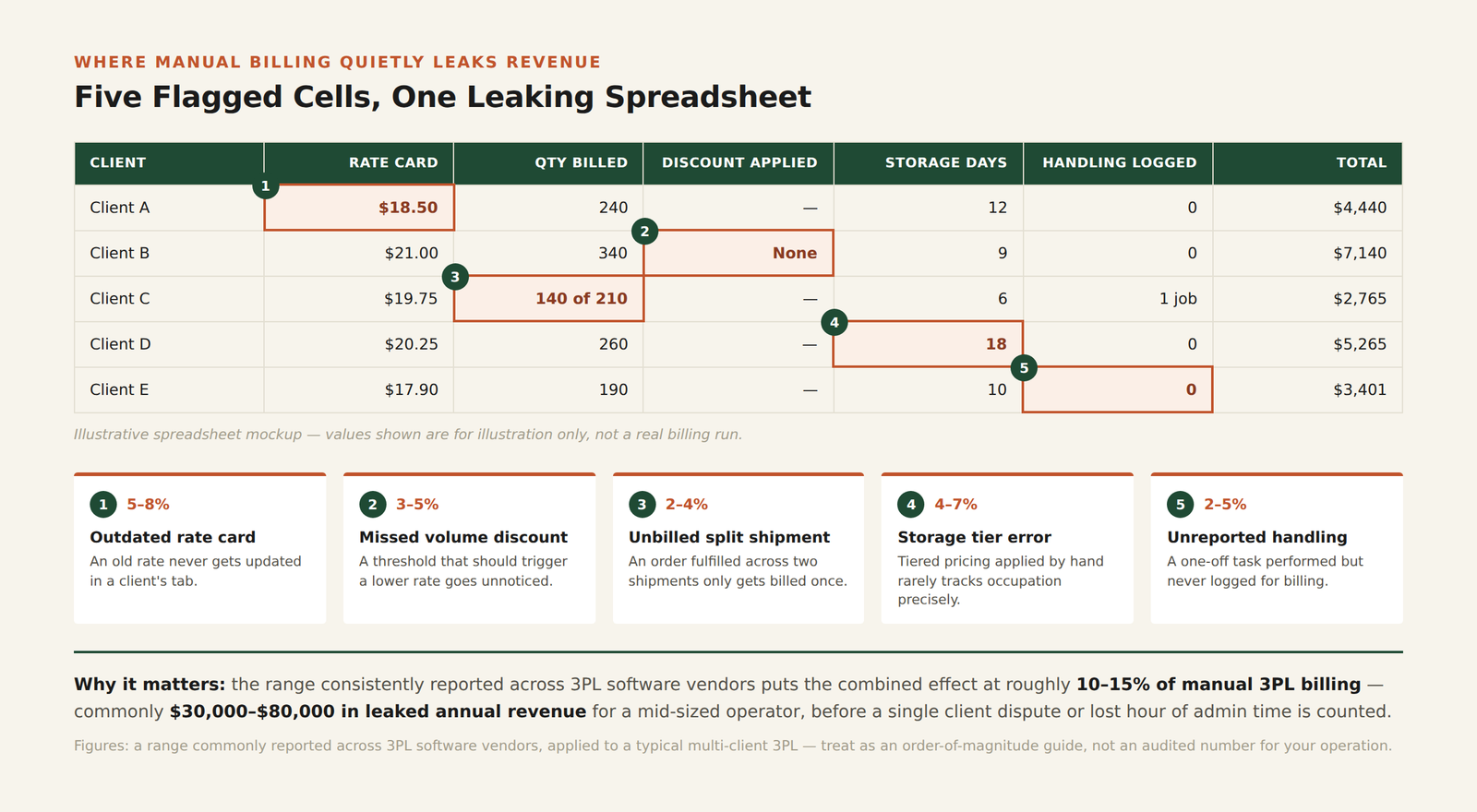
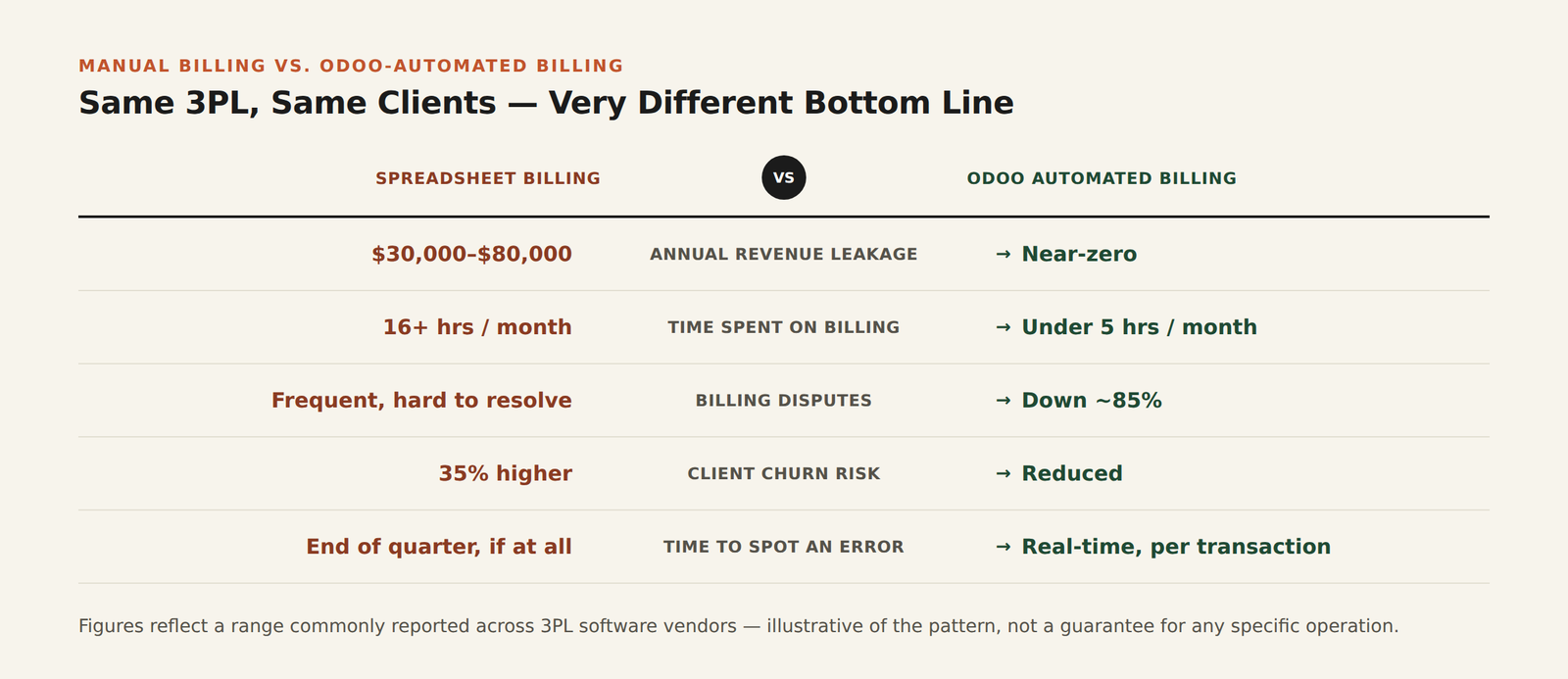
Add those five leaks together and the range consistently reported across 3PL software vendors puts the combined effect at 10–15% of manual billing, commonly $30,000 to $80,000 in leaked annual revenue for a mid-sized multi-client operator. Worth being upfront: no Australian-specific study has quantified it, and it isn’t independently audited research. It’s the pattern vendors across the 3PL software space consistently describe – treat it as an order-of-magnitude guide, not a verified number for your own operation.
The labour side is easier to localise. That same vendor-reported pattern suggests over half of 3PLs spend 16-plus hours a month on manual billing. At the current Australian average warehouse administrator rate of roughly $35.85 an hour, that works out to roughly $6,800 a year in labour cost spent reconstructing invoices by hand before a single leaked dollar is counted. That labour figure is the one number in this section built on an actual Australian data point, rather than an industry estimate.
The Client You Don’t See Losing: How Billing Errors Drive Churn
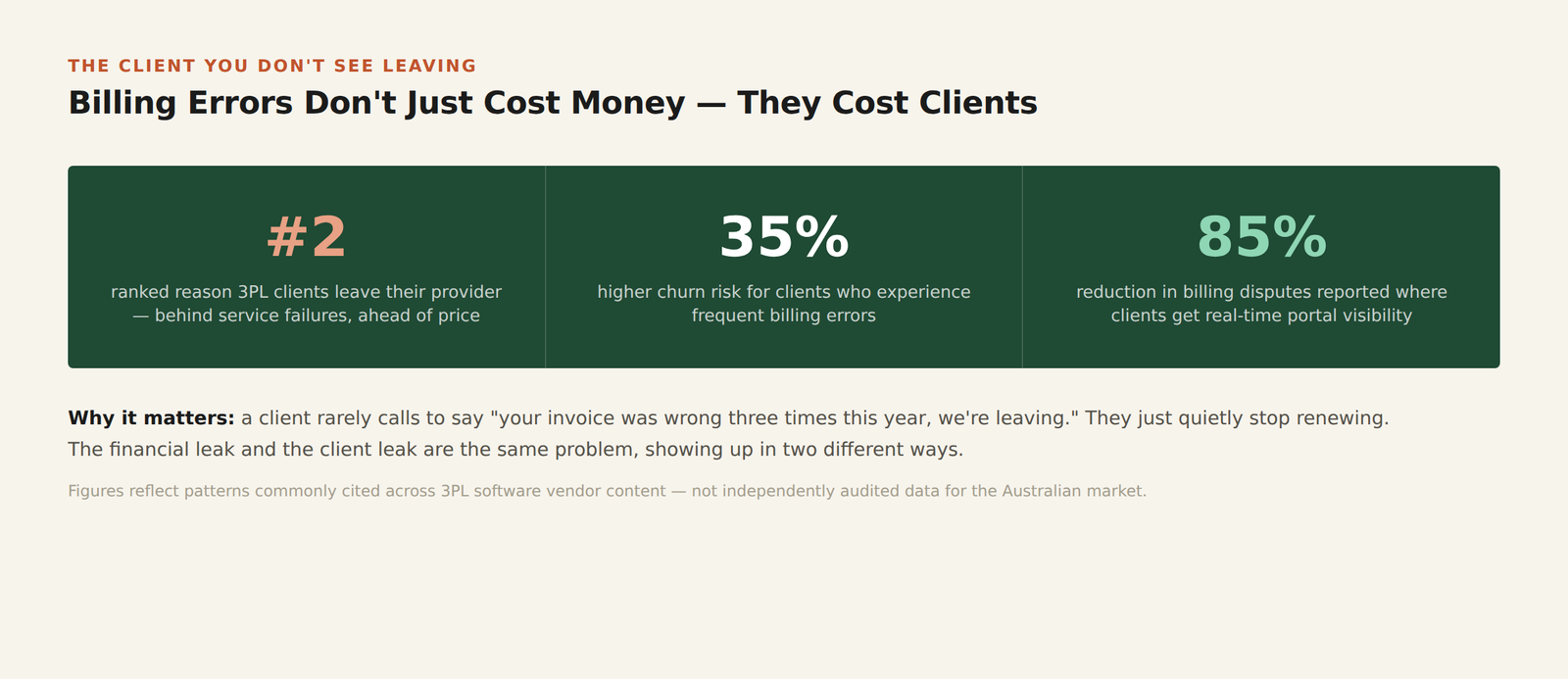
The financial leak isn’t the only cost. Billing errors are frequently cited across 3PL industry commentary as a top reason clients leave their provider, often ranked just behind outright service failures, ahead of price. Estimates for the added churn risk vary by source (some vendor analyses put it as high as 35% higher) and aren’t independently audited for the Australian market, but the underlying pattern holds up: a client rarely calls to complain three times before leaving. They just quietly decline to renew.
How Odoo Closes Each Leak
Each of the five leak points above can be addressed directly inside a properly configured Odoo setup – using the same Owner field, zone-based rate cards and client portal that make multi-client 3PL operations work in the first place. Configured this way, it operates as a genuine Odoo ERP system for logistics companies, not just a bookkeeping tool. Rate cards live in the system once and apply automatically, so an outdated rate can’t quietly persist in one client’s records. Storage billing calculates from actual occupied space and days, the kind of precision Odoo ERP software to manage warehouse operations is specifically built to provide, in place of manual tiered-pricing guesswork. Split shipments and special handling tasks generate their own billing lines directly from the transaction, rather than depending on someone remembering to log them later.
None of this requires custom development for a straightforward setup. A properly configured Odoo inventory management solution, combined with the Odoo ERP accounting software Australia teams already rely on, handles it once billing rules are built into the system; instead of rebuilt by hand every month. The same Owner field that keeps three clients’ stock separate on the warehouse floor also ties each billing event back to the right client automatically, which is why fixing revenue leakage and fixing messy multi-client operations tend to be the same piece of configuration work. Where clients sit on genuinely different contract terms, that same foundation can extend into custom Odoo ERP solutions built around each client’s specific billing logic.
Key Benefits of Moving Off Spreadsheets
3PLs that move off manual spreadsheets and adopt proper Odoo software – the kind Australian operators increasingly rely on, tend to see a few compounding advantages:
- Revenue you’re already owed – closing billing leaks is recovered margin, not new sales, which is usually the fastest payback in the business.
- Hours back for higher-value work – admin time spent reconstructing invoices moves to client service and growth instead.
- Fewer disputes, faster resolution – an Odoo ERP solution with real-time reporting cuts billing disputes by a vendor-reported ~85% in cases where it’s been measured, though that figure isn’t an independently audited benchmark.
- Clients who stay – reducing billing errors removes a top reason clients look elsewhere in the first place.
Illustrative Example: Where a Quarter’s Worth of Leaks Can Add Up
Here’s an illustrative example of how the five leak types above can compound in practice; not a documented case study of a specific business, just a realistic composite. Picture a mid-sized Brisbane 3PL running three clients off shared spreadsheets. Over a single quarter, those same five leak categories could plausibly stack up to $8,400 in missed bulk discounts, $7,200 from an outdated rate card nobody had caught, $5,400 in unbilled split shipments, and a further $26,000-plus across missed storage and handling charges – a combined $47,000 in underbilling in three months alone. Projected across a full year, that pattern alone would represent over $188,000.
Nobody in a scenario like this would be doing anything obviously wrong – rates just hadn’t been reviewed since onboarding, and split shipments were billed “when someone remembered.” Moving billing into Odoo’s rate-card and owner structure wouldn’t change a single client relationship; it would mean the business finally collecting what its own contracts already say it’s owed, while freeing up the better part of two admin days a month that had gone into reconstructing invoices by hand.
This sits alongside the groundwork covered in our guides on managing multiple warehouse locations in Odoo and improving picking and packing efficiency. Our Artego wholesale operations case study shows the same kind of transparent, automated reporting applied to distribution more broadly.
Curious how much your own billing process might be leaking? Our team can walk through your current rate cards and billing setup and show you exactly where the gaps are. Get in touch whenever you’re ready.