
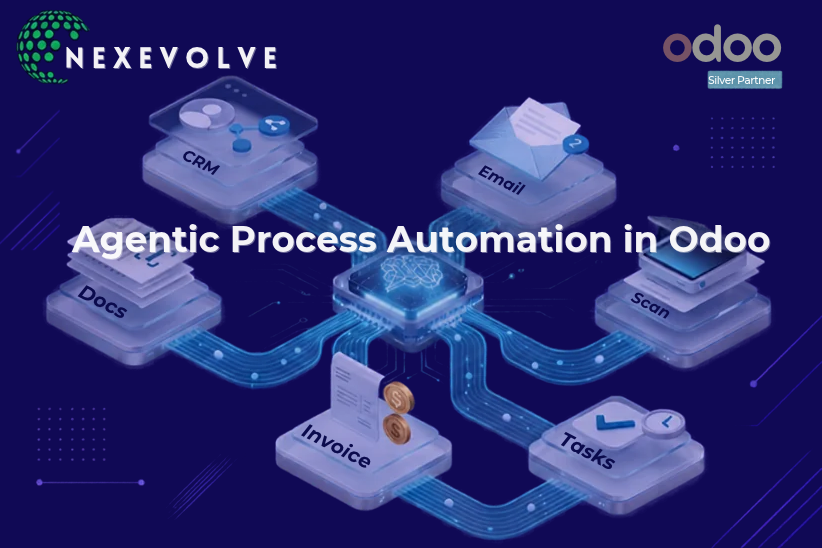
It is the 28th and your accounts team is matching supplier invoices to purchase orders by hand. Again. Meanwhile quote requests wait in an inbox, a fast mover runs low and customer emails pile up. Agentic process automation in Odoo puts a software agent on one of those jobs. It reads the work, checks it and drafts the next step, and your people approve it. We scope it per process, quote a fixed price and measure the result against your own baseline.
What Is Agentic Process Automation in Odoo?
Agentic process automation in Odoo is a software agent completing one business process inside your Odoo system, with a person approving the important steps.
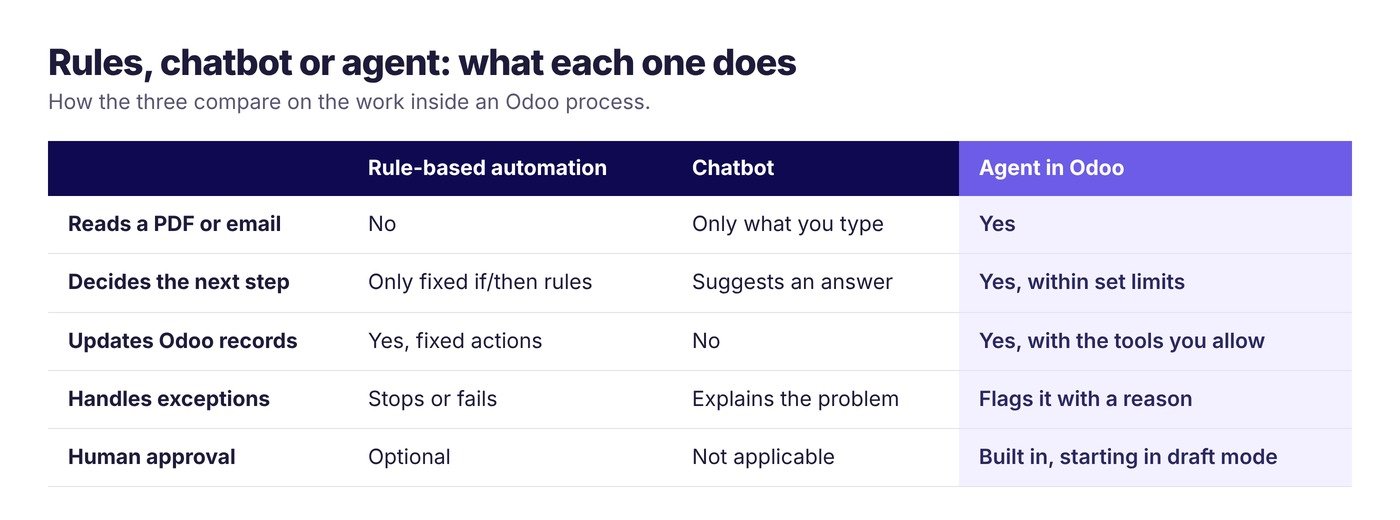
Traditional business process automation follows fixed rules: if this, then that. A chatbot only answers questions. An agent can read a messy input, such as a PDF invoice or a customer email, work out what it means and prepare the next step inside Odoo.
Odoo’s AI agents documentation describes the building blocks: a system prompt, topics with instructions, sources the agent can read and tools it can run. The standard topics cover tasks such as searching records, retrieving information and creating leads. A process like invoice matching needs purpose-built topics and tools, which is the configuration work in our scope. For the wider feature list, see our guide to AI in Odoo 19.
Which Processes Does Nexevolve Automate First?
The four below are repetitive, rule-heavy and already live in your Odoo ERP system. Each has a human check and a number we can measure.
AP Invoice Matching
The agent: reads each supplier invoice, finds the matching purchase order and receipt, and flags price or quantity differences. Odoo already links these records, so the agent adds the reading and the judgement.
Your team: approves clean matches and reviews only the exceptions.
We measure: minutes per invoice and the share matched for the first time. For many businesses, this is one of the easiest processes to start automating in their ERP system.
Quote Generation
The agent: turns a request email or web form into a draft quotation, using the right products, prices and terms from your price lists.
Your team: checks the draft and sends it. This suits made-to-order manufacturers who quote the same product families all week.
We measure: hours from request to quote sent.
Inventory Replenishment Suggestions
The agent: watches stock, sales and lead times, then suggests what to reorder and when, with the reason. It builds on Odoo’s reordering rules and replenishment report rather than replacing them.
Your team: approves the purchase orders.
We measure: stockouts, overstock and planning hours. This helps your team make better inventory management decisions, reduce inventory errors and spend less time in spreadsheets.
Customer Email Triage
The agent: reads incoming emails, tags the topic, links each one to the customer record and drafts a reply to simple questions.
Your team: handles what the agent routes to them and approves drafts at first. It is a natural fit for retail and e-commerce teams.
We measure: first response time and misrouted emails.
Read Our Latest Blog – Odoo Legacy fee in Australia
What Does Nexevolve Deliver for a Fixed Price?
One scoped process, taken from assessment to measured results, for one price agreed before work starts.
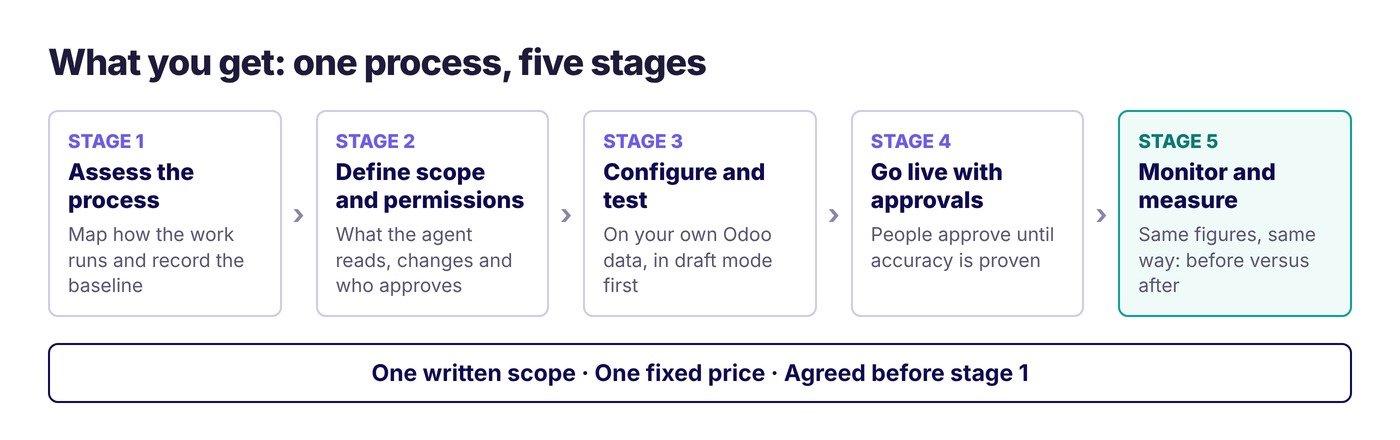
Process assessment. We map how the work runs today and record your baseline from real data.
Scope and permissions. We write down what the agent reads, what it can change and who approves.
Configuration and testing. We build the agent’s topics and tools in your Odoo environment and test them on your own data, in draft mode first.
Approval workflows. People approve the agent’s work until its accuracy is proven.
Post-launch monitoring. We measure the same figures after go-live and report the difference.
A second process gets its own scope and price, and anything outside the written scope is agreed with you first, so there are no surprises later. The benefits are easy to see: predictable cost, small risk and proof before you scale. Agents sit on top of a working system, so if Odoo is not live yet, our Odoo implementation comes first.
How Do You Measure Before and After Results?
We record a baseline before building anything, then measure the same things the same way after go-live.
Process | Baseline we record | After go-live we compare |
|---|---|---|
AP invoice matching | Minutes per invoice, first-time match rate | Same two figures, plus exceptions caught |
Quote generation | Hours from request to quote sent | Same figure, plus quotes sent per person |
Replenishment | Stockouts, overstock, planning hours | Same three, month on month |
Email triage | First response time, misrouted emails | Same two, plus replies needing rework |
Example scenario (illustrative, not a client result)
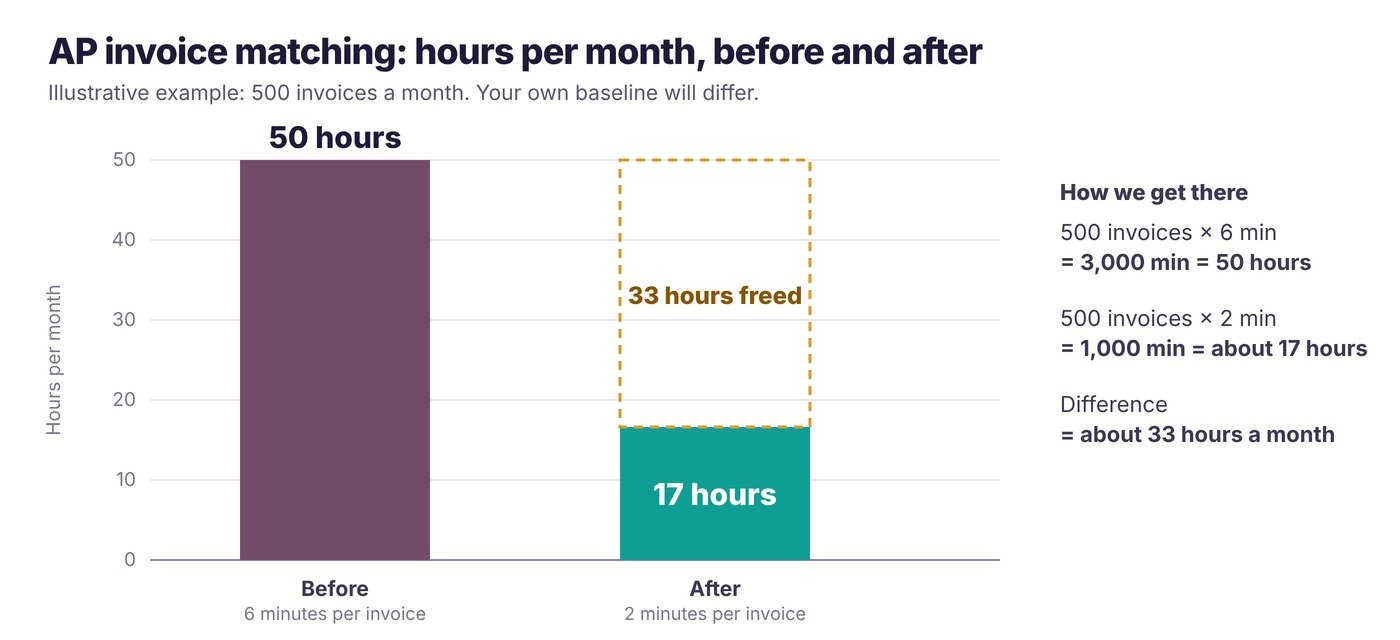
A manufacturer receives 500 supplier invoices a month. Before: a bookkeeper opens each PDF, finds the purchase order, checks the receipt and keys the bill, about 6 minutes each, or 50 hours a month. After: the agent reads the invoice, matches it to the order and receipt and drafts the bill. Anything that does not match goes to a review queue with the reason. The bookkeeper checks each draft in about 2 minutes, or roughly 17 hours a month. That frees about 33 hours for supplier queries, month-end work and other jobs that need a person. Your own baseline decides your result, which is why we measure it first.
Is Your Process a Good Candidate?
A process is a good candidate if it passes a simple four-question test.
Does it repeat at least weekly?
Low-volume work rarely repays the effort.Are the rules clear, with a few exceptions?
Agents handle the common cases and pass on the odd one.Is the data already in Odoo?
Clean products, suppliers and customers matter more than clever prompts.Can a person check the result in seconds?
If not, keep a human in the loop for longer.
Judgement-heavy work, such as pricing a one-off project or settling a supplier dispute, stays with your people.
Where Does Agentic Automation Go Wrong?
No baseline. Without one, “faster” is only a feeling. Fix: record minutes, errors and handovers before you build.
Too much freedom, too soon. Fix: start in draft mode and widen permissions only as accuracy proves out.
Messy data. Duplicate suppliers and old price lists confuse people and agents alike. Fix: clean the records the agent will use before go-live.
Privacy gaps. Emails and invoices hold personal and commercial data. Fix: check which AI provider processes it and limit the agent to the records it needs.
No owner. Fix: name one person who reviews exceptions and checks the scorecard every month.
How Do You Get Started?
Agentic process automation in Odoo works best when it is small, scoped and measured. Pick the process that costs your team the most hours, agree a fixed price and let the numbers decide what comes next. As an Odoo Silver Partner in Australia, Nexevolve can scope it with you, and our Sydney Odoo consultants are ready to help.
Which process is taking up the most time in your business? Tell us what is slowing your team down. We will help you assess whether it is a good fit for agentic automation, what can be measured and what it would cost. Book a free scoping call with Nexevolve |