
By the Nexevolve team | Odoo Silver Partner, Australia
Can you list every place your business uses AI?
On Thursday 10 December 2026, a new Privacy Act requirement starts, just over two weeks away. If a computer program makes, or helps make, a decision that could significantly affect a person, and it uses their personal information, your privacy policy may need to disclose how that happens.
AI governance means the records, rules and checks that guide how your business uses AI. It covers more than tools labelled AI.
For an Odoo business, a practical starting point is to list where AI and automation are used, set a short usage policy and review your privacy policy.
What Changes for Australian Businesses on 10 December 2026?
From 10 December 2026, APP entities (organisations covered by the Privacy Act) must include additional information in their APP privacy policies when they have arranged for a computer program to make, or do something substantially and directly related to making, a decision that could reasonably be expected to significantly affect an individual’s rights or interests, using that person’s personal information.
The requirement has three parts:
Part | What must be true |
|---|---|
Part 1 | A computer program makes, or does something substantially and directly related to making, a decision. |
Part 2 | The decision could reasonably be expected to significantly affect an individual’s rights or interests. |
Part 3 | The program uses that person’s personal information. |
Where these conditions are met, the privacy policy must describe the kinds of personal information used, the kinds of decisions made solely by computer programs, and the kinds where a program does something substantially and directly related to a human decision.
The requirement applies to APP entities. Most private-sector businesses with annual turnover above $3 million are covered by the Privacy Act. Some smaller businesses are also covered, including health service providers and businesses that trade in personal information. Check the OAIC small business guidance to understand whether your organisation is covered.
Two points catch businesses out. First, “computer program” is broad. Under the OAIC’s final APP 1 guidelines, released on 30 September 2026, it covers pre-programmed rule-based processes, artificial intelligence, machine learning and generative AI tools. Being a computer program is not enough on its own, though. All three conditions must be met, so a spam filter or inbox sorter is unlikely to be covered.
Second, human oversight does not automatically take a process outside the requirement. If a computer program substantially influences and is directly connected to the human decision, it may still be covered. The extent to which a human decision-maker relies on the program’s output is one factor when assessing whether the program substantially and directly contributes to the decision.
Take the 8-Question AI Governance Check
Tally your Yes, No or Not sure answers below (count Not sure as No), then check your score tier underneath.
# | Question | Yes | No | Not sure |
|---|---|---|---|---|
1 | Do you have a written list of every AI tool and automation your business uses? | ☐ | ☐ | ☐ |
2 | Does each tool on that list have a named business owner? | ☐ | ☐ | ☐ |
3 | Do you know which tools use personal information about customers, staff or suppliers? | ☐ | ☐ | ☐ |
4 | Have you checked whether any tool scores, approves, prices, ranks or screens people? | ☐ | ☐ | ☐ |
5 | Do staff have a written AI usage policy, including what data must never go into an AI tool? | ☐ | ☐ | ☐ |
6 | Do you record who checks an AI tool’s output before it affects a person? | ☐ | ☐ | ☐ |
7 | Do you have a process for explaining and reviewing automated decisions that affect people? | ☐ | ☐ | ☐ |
8 | Has your privacy policy been reviewed against the new automated decision-making wording? | ☐ | ☐ | ☐ |
What Does Your AI Governance Score Mean?
Count your Yes answers, then find your tier below.
Yes answers | What it usually means | What to do next |
|---|---|---|
7 to 8 | Core records are in place | Check your privacy-policy wording against the OAIC guidance, and recheck when tools change |
4 to 6 | Some records, some gaps | Work through your No answers below, starting with the inventory |
0 to 3 | Little is written down | Do the inventory and privacy-policy wording first, then the rest |
This score is an internal readiness guide, not a legal compliance assessment. Even a score of seven or eight does not automatically mean your business meets its Privacy Act obligations.
What Should You Do About Each Gap?
Match each No to a fix: questions 1 to 3 need an AI inventory, 4 an impact assessment, 5 and 6 a usage policy, and 7 and 8 a privacy-policy update.
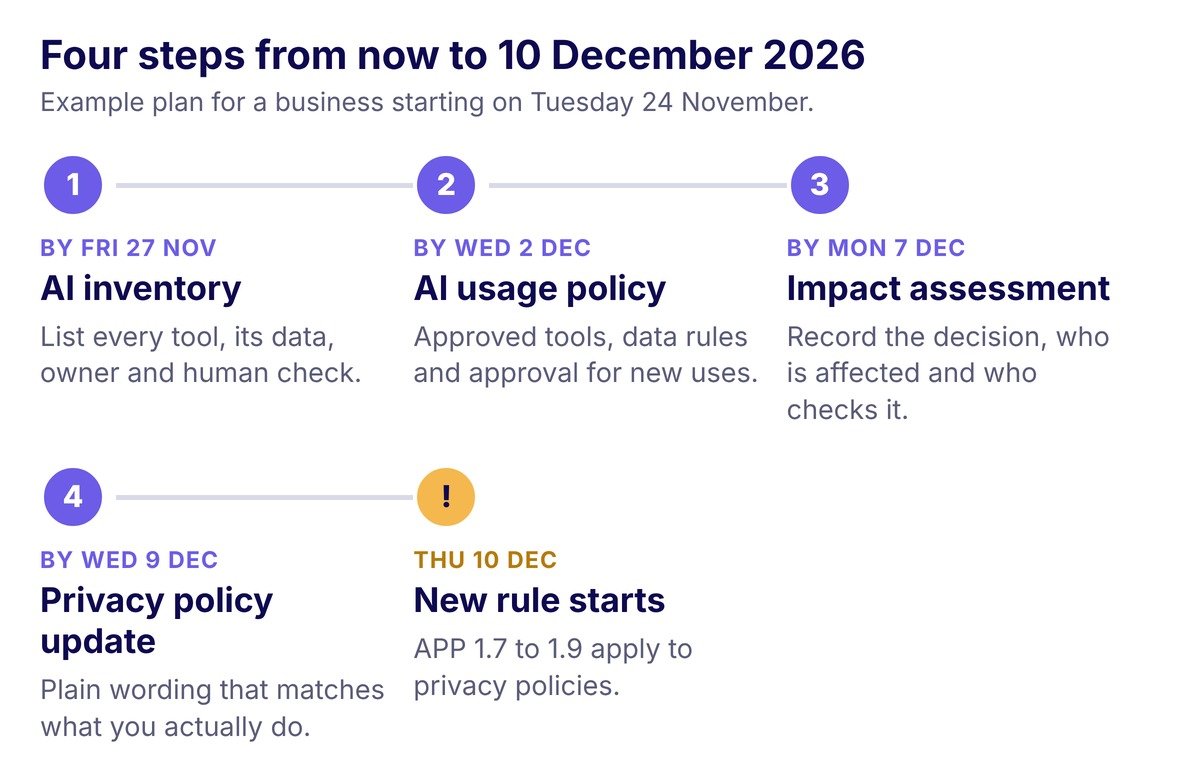
Questions 1 to 3: Build the AI inventory
For each AI tool or automation, record:
- What it does.
- What personal information it uses.
- Who owns it.
- Whether a person checks the result.
In an Odoo ERP system, include AI agents, automated actions that approve or reject, and tools staff use on their own. Everything sits in one system, so Odoo is a practical place to start.
Odoo’s AI agents documentation describes the settings that define an agent: a system prompt, topics, sources and tools. Record those, and note which AI provider, such as ChatGPT or Gemini, receives the data. Relying on a vendor’s tool does not remove the obligation, as you may still be treated as having arranged for it.
Do not stop at tools labelled AI, as rule-based and scoring processes may count too. The National AI Centre’s Guidance for AI Adoption includes a ready-made AI register template.
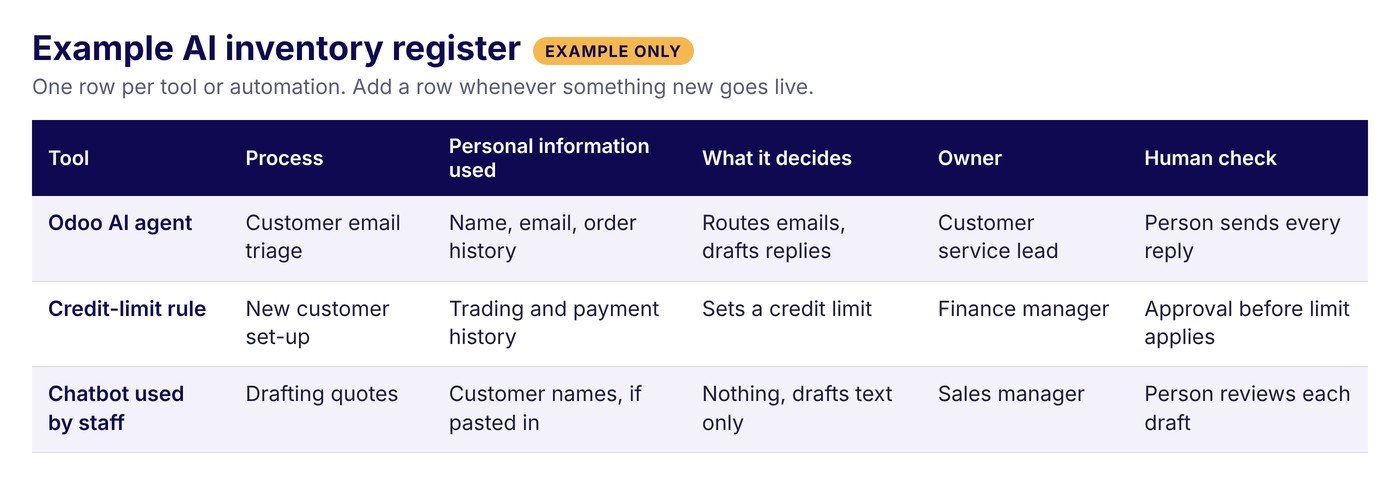
Question 4: Run an impact assessment
For each tool that touches people, record:
- The decision it makes.
- Who is affected.
- What personal information it uses.
- What could go wrong.
- How a person can question the result.
Not every automated process creates a significant impact. Assess each against the three APP 1.7 conditions and record your reasoning. Start with the uses below, the most likely to significantly affect people.
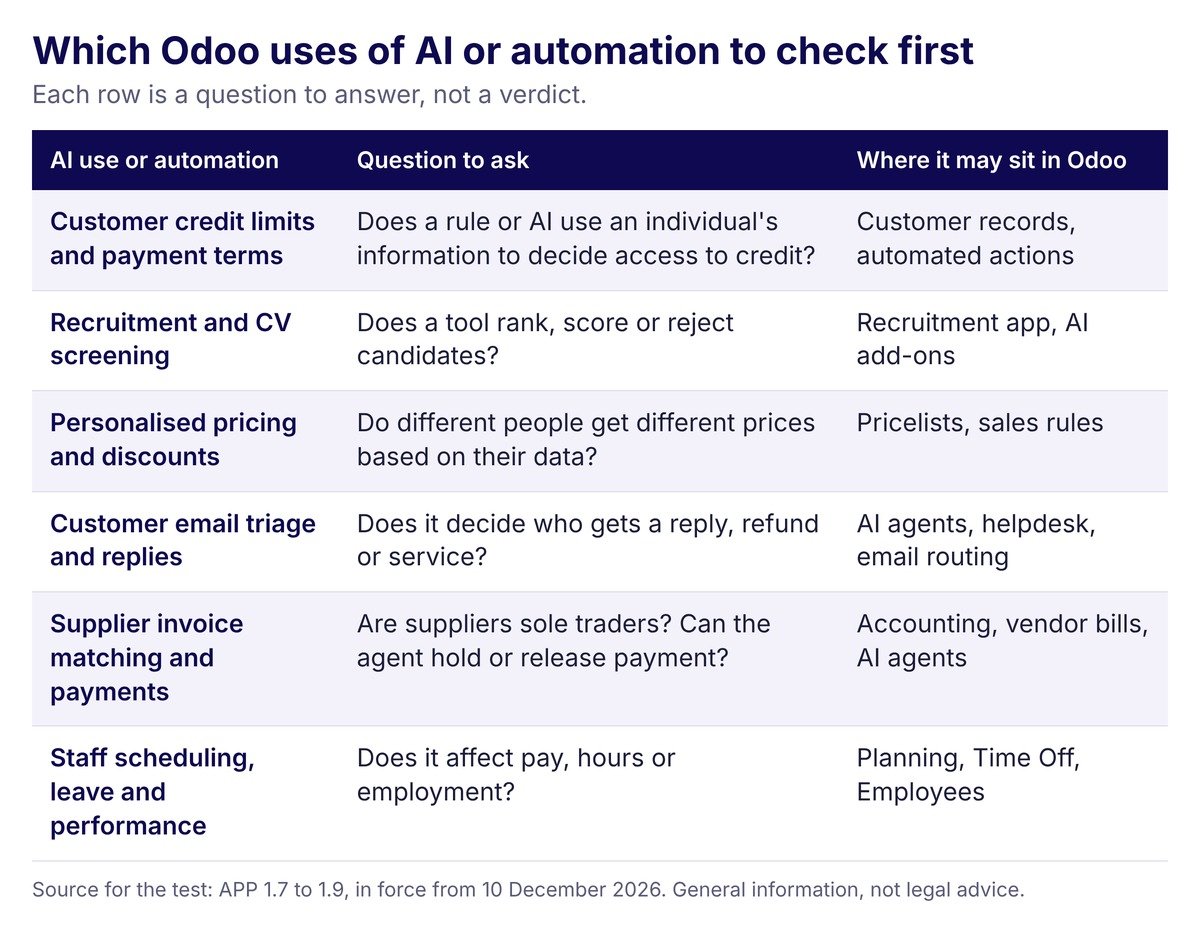
Most Odoo business process automation, such as matching a supplier invoice to a purchase order in our guide to agentic process automation in Odoo, may not significantly affect an individual at all, but record that judgement. The same goes for tools staff use outside Odoo, such as a chatbot. Retailers should check personalised pricing and email triage first, so Odoo ERP for retail and e-commerce teams is a sensible place to begin.
Questions 5 and 6: Write the AI usage policy
Keep it to one or two pages. Cover approved tools, data that must never go into an AI tool, who approves a new use and when a person must check the output.
Questions 7 and 8: Update your privacy policy
Update your privacy policy to describe the kinds of personal information used and the kinds of decisions made by, or assisted by, computer programs. As good practice, also explain how individuals can request information or raise concerns about an automated decision.
Illustrative wording only: “We use software to help set customer credit limits. It uses the contact, trading and payment information you give us. A member of our team reviews each decision before we confirm it.”
Your policy should describe the actual kinds of personal information used and decisions made or assisted by computer programs in your business, and distinguish fully automated decisions from those where software substantially and directly assists a person. You do not have to disclose commercially sensitive details, but the exclusion is narrow.
Does Australia Have an AI Act, and What Else Applies?
No, Australia has no standalone AI Act, so AI use is governed by existing laws such as the Privacy Act, together with voluntary government guidance.
The Guidance for AI Adoption, published on 21 October 2025, streamlined the government’s earlier 10 guardrails into six practices. The new disclosure may also help individuals exercise rights under frameworks such as anti-discrimination law, so how a tool reaches its decision matters as much as whether you disclose it.
What Does Nexevolve’s AI Governance Package Include?
Nexevolve’s AI governance package has four deliverables: an AI inventory, an AI usage policy, an impact assessment and draft privacy-policy wording, agreed in one written scope at a fixed price.
Deliverable | What you receive | Who signs it off |
|---|---|---|
AI inventory | A register of AI tools and automations in your Odoo ERP system, with owner, data and human checks | Your business owner |
AI usage policy | A short staff policy on approved tools, data rules and approval for new uses | Your leadership team |
Impact assessment | A short assessment of tools that may make or substantially assist decisions affecting individuals | You |
Privacy-policy update | Draft policy wording on personal information and decision types | Your business owner |
What we need from you Your current privacy policy, a list of the tools and Odoo apps in use, and one named person who knows how each process runs. |
If Odoo is not live yet, our Odoo ERP implementation services come first. See also our guide to AI in Odoo 19.
How Do You Get Started?
Begin with your score to see where your business needs the most attention. Nexevolve can help you prioritise the four deliverables and agree on a practical scope. We are an Odoo Partner in Australia at Silver level, and our Odoo consultants in Sydney are ready to help.
Know Where Your Business Stands with AI Governance?
Whether you are already using AI agents in Odoo or relying on multiple AI tools across your business, understanding where they use personal information and influence decisions is a good place to start.
Share your checklist results with Nexevolve. We will help you identify the gaps, understand the work involved and scope the next steps.
Book a free AI governance scoping call with Nexevolve →
This article provides general information, not legal advice. See the OAIC’s guidance, or seek your own advice, on how the Privacy Act applies to your business.